Grow Lighting: Turn PPFD and DLI into a Useful Specification
Compare grow lights using canopy measurements, daily light dose and a clear energy boundary, then write an acceptance test for the installed system.
Explore the guide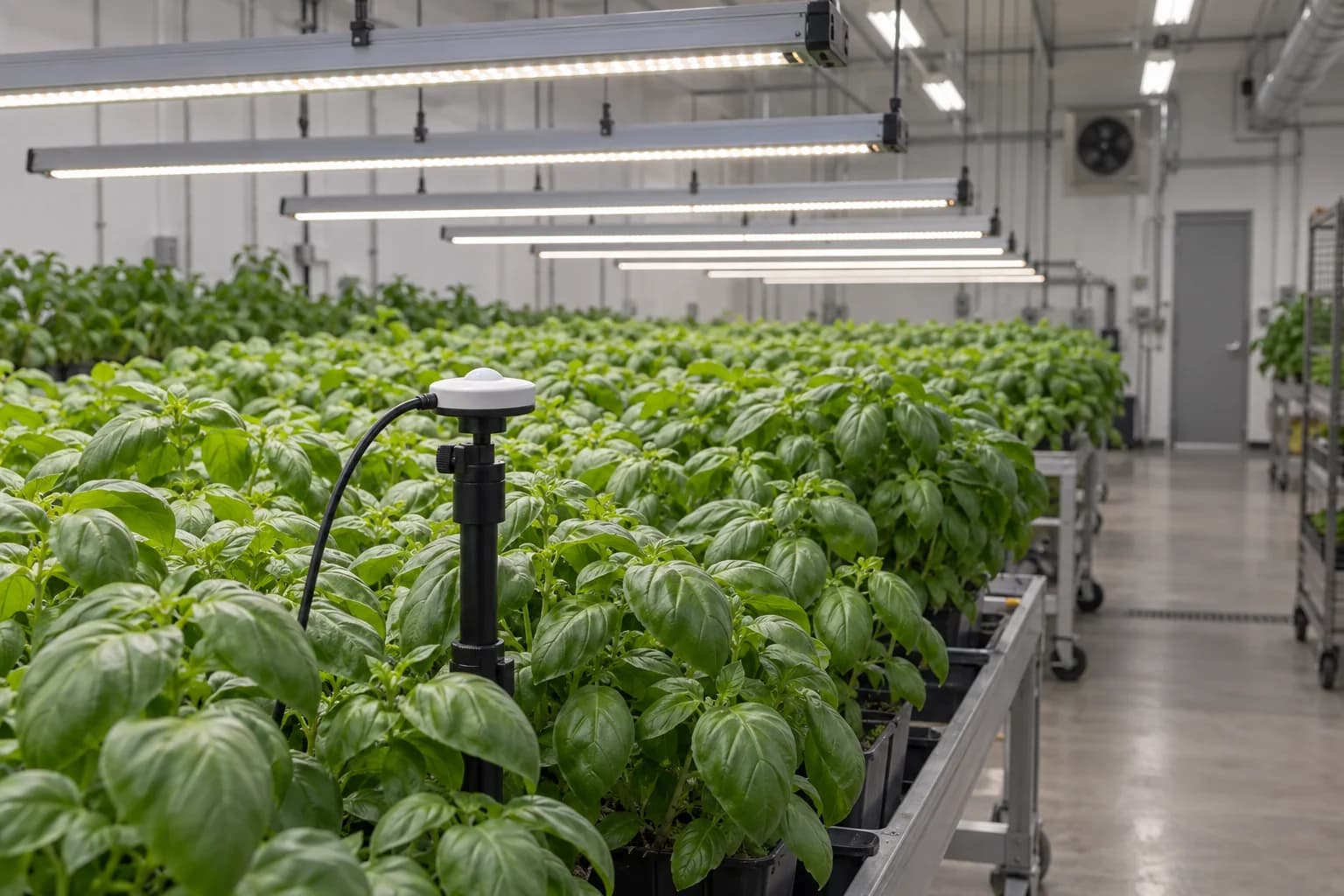
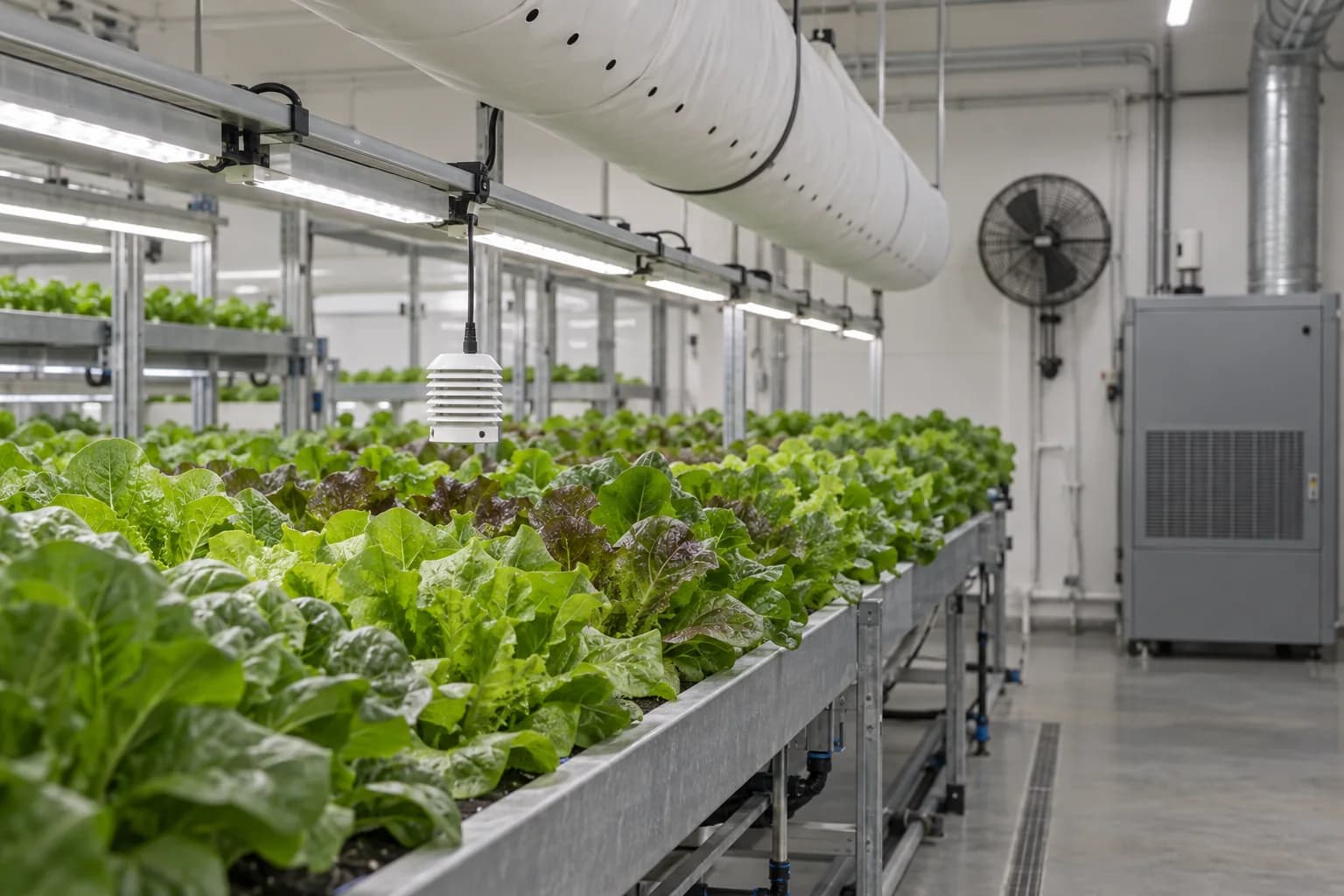
A fixture’s efficiency is only one part of a lighting decision. The installed system must deliver the intended light across the growing surface, follow a suitable schedule and fit the facility’s electrical and climate design. Start with the crop specification and finish with a measured canopy map.
Measure the growing plane
Compare the delivered PPFD distribution, including edges and low points.
State the daily dose
Pair the intensity with photoperiod and a consistent wavelength definition.
Define the energy boundary
Separate lighting electricity from the rest of the facility.
Use the right metric for the question
Photosynthetic photon flux density, or PPFD, describes the photon arrival rate per unit area, commonly measured over 400–700 nm in µmol/m²/s. Daily light integral, or DLI, accumulates the dose over a day in mol/m²/day. Michigan State University’s indoor-lighting guide distinguishes the instantaneous measurement from the daily total. MSU indoor lighting guide.
Photosynthetic photon flux, or PPF, is a fixture output in µmol/s; photon efficacy, or PPE, relates the stated photon output to electrical input in µmol/J. These fixture metrics do not describe how evenly light reaches a particular canopy. The DLC horticultural requirements are a reference for tested product metrics, not a substitute for measuring the installation.
In a tender, write the measurement plane, mounting height, growing footprint and operating power beside the requested values. Ask how results change when benches move or the canopy height changes. A comparison is meaningful only when the geometry and measurement conditions are clear.
Calculate DLI, then keep the crop response separate
For a constant PPFD during the light period, DLI = PPFD × light hours × 0.0036. For a changing schedule, calculate each interval and add the doses. In a greenhouse, account for daylight as well as supplemental lighting. The worked comparison below uses an assumed constant artificial-light level. DLI calculation reference.
At 250 µmol/m²/s for 16 hours, the calculated dose is 14.4 mol/m²/day. At 400 µmol/m²/s for 10 hours, it is also 14.4. Equality in this arithmetic does not establish equal crop performance. Choose the intensity and day length for the crop and stage, then test the proposed programme with the relevant agronomic evidence.
Use our DLI calculator to explore the relationship. Keep its output attached to the input assumptions rather than presenting it as a yield prediction.
Two schedules. The same calculated DLI.
| Assumed schedule | PPFD | Light period | Calculated DLI |
|---|---|---|---|
| Schedule A | 250 µmol/m²/s | 16 h/day | 14.4 mol/m²/day |
| Schedule B | 400 µmol/m²/s | 10 h/day | 14.4 mol/m²/day |
Specify a map rather than a single centre reading
Ask for a predicted map before procurement and an agreed measurement grid at commissioning. Include edges, spaces between fixtures and any working areas excluded from the growing footprint. Define whether the reported mean includes those spaces. A centre reading alone cannot verify the whole bench.
MSU’s lighting uniformity guide discusses the distribution of light at the crop. MSU light intensity and uniformity. For the project acceptance sheet, Hamfy proposes reporting the mean, minimum and maximum PPFD, the grid spacing and the mounting height together. If using a uniformity ratio, write its formula so different suppliers use the same one.
Measure with the intended fixture settings and a suitable, checked sensor. Record other light sources, obstructions and the plant canopy present during the test. If the predicted map assumes an empty reflective room, compare that assumption with the installed growing configuration before accepting the design.
Keep wavelength definitions and electricity boundaries consistent
A photon metric is incomplete without its wavelength range. Zhen and Bugbee’s research showed that far-red photons can contribute to photosynthesis when combined with shorter-wavelength light under the tested conditions. It does not make differently defined photon-efficacy figures interchangeable. Zhen and Bugbee, 2020.
Ask suppliers which wavelength range is included in each PPF and PPE value. Compare like with like and retain the spectrum information in the specification. A spectral claim should identify the tested crop and conditions before it is used to justify a particular programme.
For an energy estimate, start with measured or specified system input power, including drivers, at the intended dimming level. Multiply by the operating hours. Add the loads required by the chosen design—cooling, dehumidification, fans, pumps and other equipment—when calculating whole-facility electricity. Keep those line items visible rather than hiding them in a single unexplained efficiency factor.
Make the lighting handover measurable
Hamfy recommends agreeing on the acceptance test before ordering equipment. It should define the growing plane, grid, operating settings, target distribution, meter record and acceptable deviations. Include checks that dimming commands and schedules reach the correct zones and recover as intended after an interruption.
For an operating comparison, report lighting kWh separately from whole-facility kWh. If using kWh per kilogram, define the saleable output, crop period and area basis. Do not treat a fixture efficiency improvement as a measured change in crop cost before the complete production record exists.
The final specification should connect the light map to climate and moisture removal. A crop programme changes several loads at once. A coordinated review helps the team see what the lighting choice requires from power distribution, controls and HVAC.
Common questions
Can two installations with the same DLI produce different results?
Yes. DLI is a daily photon total. It does not fully describe light distribution, spectrum, photoperiod, intensity over time or the surrounding crop conditions. Use it as one part of a crop-specific lighting specification.
Is the fixture with the highest PPE always the best choice?
PPE is useful when measurement definitions match, but the design also needs adequate delivery and distribution at the canopy, suitable controls, serviceability and a supported crop programme. Evaluate the installed system against the agreed specification.
Sources & research
Primary sources selected for this article. Reviewed by Hamfy on .
What belongs in an indoor grow-light specification?Read the research brief · scope, findings and limitations- University technical guide · 2021Indoor Lighting GuideMichigan State University
Source for conventional PPFD and DLI definitions and the constant-light dose calculation.
- University technical guide · Accessed 2026Urban Agriculture: Light Intensity and UniformityMichigan State University
Informs the distinction between average light level and distribution across the crop.
- Product qualification requirements · Version 4.0 · 2025Horticultural Lighting Technical RequirementsDesignLights Consortium
Reference for tested fixture metrics. This voluntary programme is not described here as a European legal requirement.
- Peer-reviewed experiment · 2020Far-red substitution, canopy quantum yield and photon capture in lettuceZhen & Bugbee · Frontiers in Plant Science
Supports checking wavelength definitions and the context of far-red findings. It does not supply a universal lighting recipe.
Have a correction or additional project evidence? Contact the Hamfy team.
Build a lighting specification the team can verify
Share your crop plan and growing layout. We can help connect light delivery, operating schedules, controls and facility loads.