Hydroponic Water Quality: Beyond pH and EC
Learn what pH and EC reveal, what they miss, and how to build a practical sampling and monitoring plan for a recirculating growing system.
Explore the guide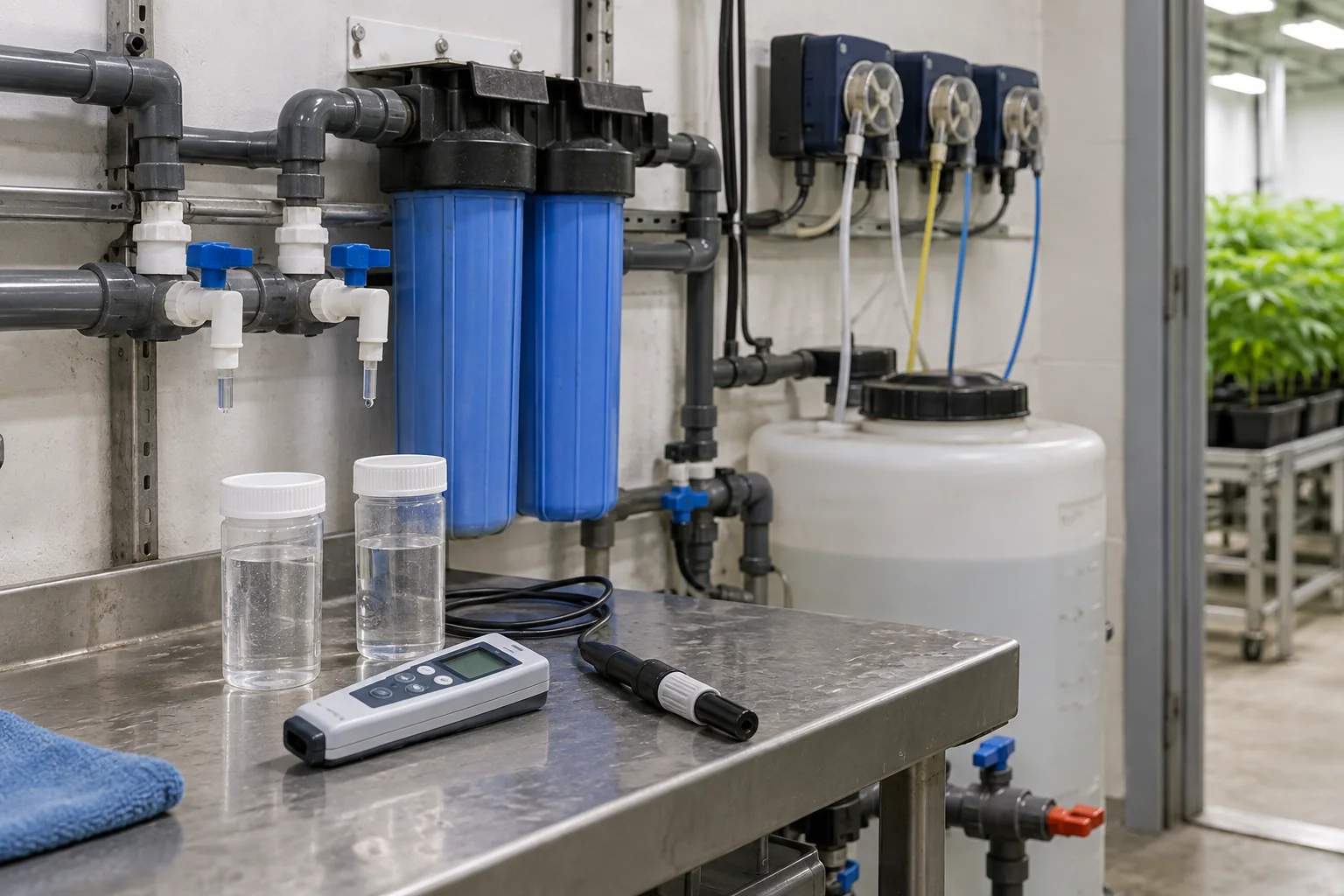
pH and EC are useful operating measurements, but two plausible readings do not describe the whole nutrient solution. A good water plan follows the water from its source through treatment, dosing, the root zone and the return line. Each location answers a different question.
pH is not alkalinity
Measure buffering capacity as part of the source-water assessment.
EC is not a nutrient recipe
A conductivity reading does not identify the individual ions.
Sample the whole loop
Distinguish source, freshly mixed feed and returning solution.
Start with the water entering the facility
Before choosing treatment equipment, obtain a laboratory analysis of the intended source. UMass recommends analysing irrigation water before construction and considering alkalinity, salts and relevant individual elements. UMass water analysis guidance. The result gives the design team a starting composition; it is not a guarantee that the source remains constant.
Hamfy proposes recording the source, sampling point, date and recent treatment or supply changes with every laboratory result. If the source varies, agree with the laboratory and crop specialist when repeat samples are needed. Keep the raw-water sample distinct from water collected after a softener, filter, membrane or storage tank.
The practical question is what the incoming water contributes to the finished solution. Ask the designer to explain which findings require treatment, which can be accommodated in the nutrient formulation and which need monitoring. This avoids specifying equipment simply because it appears in another farm’s installation.
Give pH, alkalinity and EC separate jobs
pH describes acidity or basicity; alkalinity describes acid-neutralising capacity. They are related in water management but are not interchangeable measurements. EC describes electrical conductivity and is used as an indicator of dissolved ionic salts. It cannot identify whether the measured conductivity comes from the intended nutrients or other ions. Oklahoma State’s hydroponic pH and EC guide.
Ask for laboratory units exactly as reported. In the operating log, standardise conductivity units: 1 mS/cm equals 1,000 µS/cm. Record temperature compensation and use the same comparison basis for trend analysis. Do not compare values from different instruments until their settings and reference checks are understood.
A stable EC does not prove that each nutrient is available in the desired proportion. Equally, a changing pH is a signal to investigate the system history, water composition and measurement quality. A dosing decision needs more context than the latest dashboard value.
What the measurement can answer
| Measurement | Useful question | What it does not establish |
|---|---|---|
| pH | How acidic or basic is this sample? | Buffering capacity or a complete nutrient balance |
| Alkalinity | How strongly does the water neutralise added acid? | The concentration of every nutrient |
| EC | How conductive is the solution on this measurement basis? | Which ions are producing the conductivity |
| Laboratory ion analysis | Which reported ions are present, and at what concentrations? | Continuous conditions between samples |
Use source, feed and return as distinct sampling points
A source sample characterises the incoming water. A feed sample checks the solution after preparation. A return sample helps investigate what is arriving back from the growing system. Label those locations physically, put them on the water diagram and keep their records separate.
For a recirculating system, compare the three locations alongside tank level, make-up volume, dosing events and irrigation state. A sample immediately after a dosing pulse may answer a different question from a well-mixed reservoir sample. Agree on sampling conditions so that a trend is not just a record of changing technique.
Hamfy suggests beginning with a simple operating sheet: timestamp, point, pH, EC, solution temperature, system state and action taken. Add dissolved oxygen where the growing method and root-zone assessment justify it. Give that sensor its own maintenance and verification procedure instead of assuming it is a permanent reference.
Specify what each treatment stage is meant to do
Write a purpose beside each proposed treatment stage. Particle filtration, dissolved-ion management and microbial control address different questions. Ask suppliers for evidence against the specific objective at the required flow and water conditions. Clear water, acceptable pH and acceptable EC do not by themselves demonstrate successful microbial treatment.
The University of Vermont’s hydroponic produce-safety guidance explains that circulating water can connect contamination across a system and emphasises the design and cleaning of water-contact surfaces. UVM hydroponic and aquaponic guidance. Include accessible pipework, drainable components and a documented cleaning process in the design discussion.
Keep plant-health management and produce-safety requirements visible as separate responsibilities. The operating team should know who interprets laboratory results, who authorises changes and what evidence is required before a treated loop returns to service. This guide does not supply a chemical dosing recipe; that specification needs the actual water analysis, equipment and intended use.
Build an action log alongside the trend chart
Check the instrument before chasing a surprising number. Follow its documented calibration and cleaning procedure, compare an independent sample where appropriate, and record whether the anomaly was confirmed. An unexplained correction can erase evidence of a sensor problem.
Define what happens when a value leaves the agreed operating range: remeasure, inspect a named part of the system, take a laboratory sample or escalate to the responsible specialist. Record the decision and subsequent result. The same alarm should not return each week without a growing record of what caused it.
Review water use with an explicit boundary. Distinguish make-up water, discharged solution, recovered condensate and water delivered repeatedly through the same loop. Claims about savings should name the baseline, crop output and time period. To prepare the engineering discussion, gather those records in the project preparation guide.
Common questions
Can EC show that all nutrients are balanced?
No. EC is an aggregate conductivity measurement. It is useful for routine management, but individual-ion information and the system history are needed to investigate the composition of the solution.
Should every hydroponic farm use reverse osmosis?
The source-water analysis and the intended nutrient solution should drive that decision. Ask what needs to be removed, what water quality the selected equipment can achieve, and how reject water, energy, maintenance and nutrient formulation will be handled.
Sources & research
Primary sources selected for this article. Reviewed by Hamfy on .
A measurement plan for a recirculating nutrient solutionRead the research brief · scope, findings and limitations- University extension · Accessed 2026Electrical Conductivity and pH Guide for HydroponicsOklahoma State University Extension
Supports the distinction between routine pH/EC monitoring and water chemistry. Crop tables are contextual examples, not a universal recipe.
- University extension · Accessed 2026Water AnalysisUMass Extension
Informs the source-water sampling and laboratory assessment before system design.
- University technical guidance · Accessed 2026Produce Safety in Hydroponic and Aquaponic OperationsUniversity of Vermont · NECAFS
Supports the discussion of recirculation, water-contact surfaces and cleaning. Its US regulatory context is not presented as European law.
Have a correction or additional project evidence? Contact the Hamfy team.
Make the water system part of the facility design
Share the source-water report, growing method and intended recirculation scheme. We can help define the data and engineering questions before equipment is selected.