PlantVillage: Why Plant-Disease AI Needs Testing Beyond the Lab
What published PlantVillage and cassava studies teach us about evaluating plant-disease cameras under the conditions where growers will use them.
Explore the guide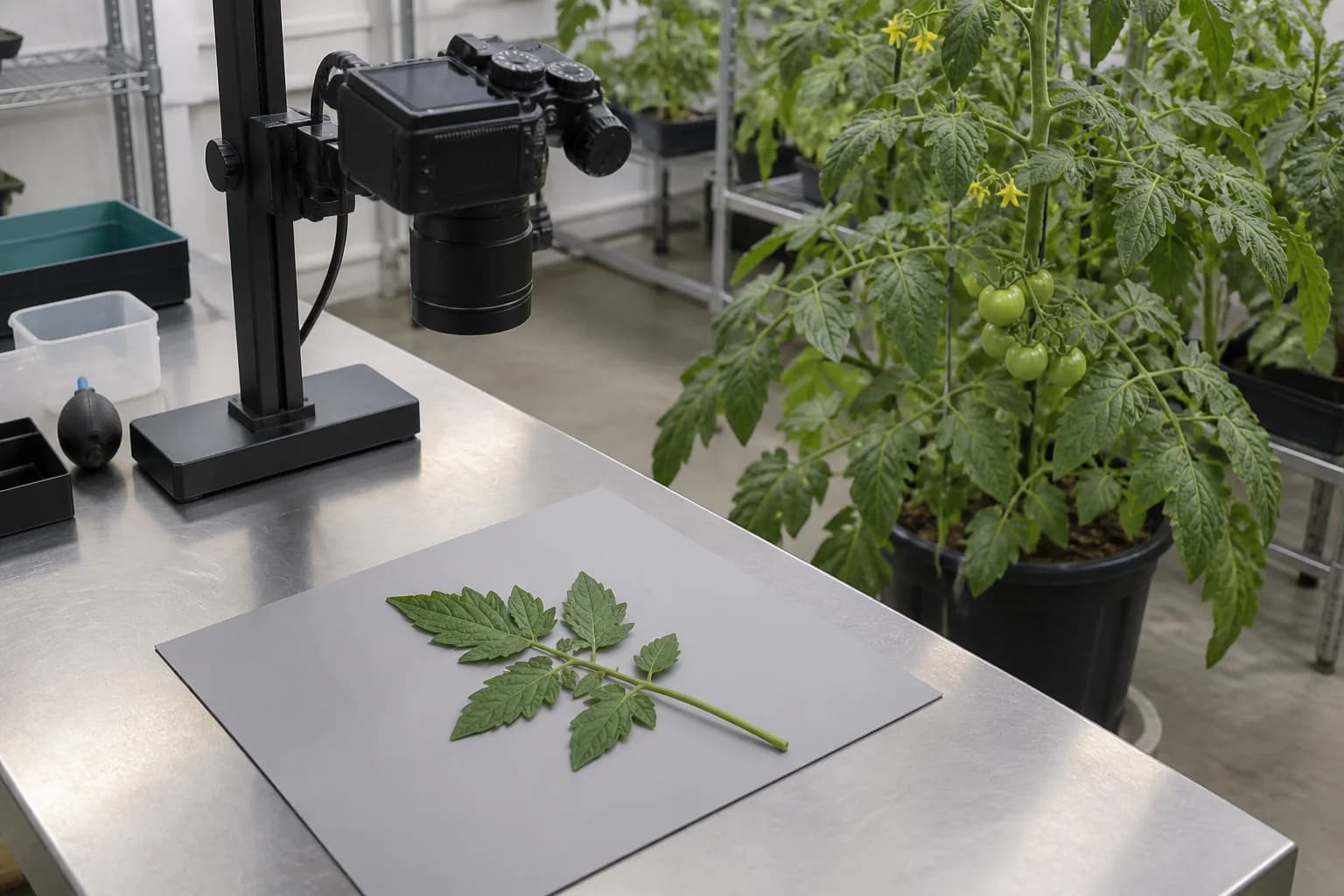
A model can perform well on familiar images and still need substantial work before it is useful to a grower. Two published plant-disease studies make the testing problem concrete. Their value for an indoor camera project is a better evaluation plan, not a prediction of how every modern model will perform.
Name the test
A score needs its dataset, task, metric and evaluation conditions.
Test the intended setting
Include the actual camera view, crop stages and difficult observations.
Make uncertainty usable
Keep an inspection route for ambiguous or unfamiliar cases.
The project: learning from labelled leaf images
In 2016, Mohanty, Hughes and Salathé studied disease classification using 54,306 PlantVillage images covering 14 crop species and 38 crop–condition classes. Their best reported held-out classification accuracy was 99.35%. Original PlantVillage study.
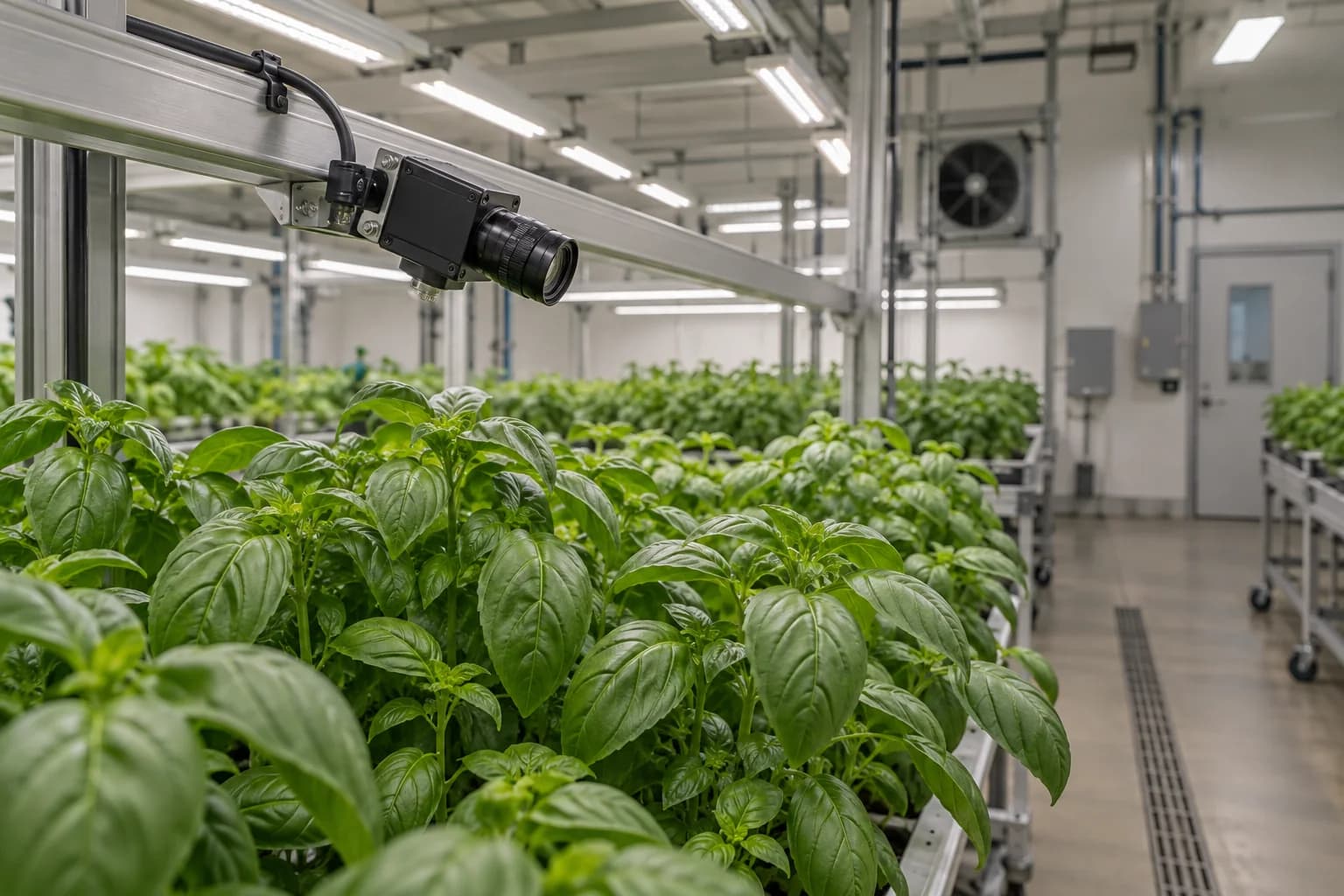
The important evaluation question is what an unseen image means. A held-out image can be unseen during training while still resembling the training collection closely. A camera installed above a bench introduces another question: whether the image acquisition and plant presentation match the conditions represented by that collection.
Before using any published accuracy figure in a procurement discussion, ask for the exact label being predicted. Classifying a prepared leaf image, locating a symptom within a canopy and identifying the cause of a crop problem are different tasks. A result for one should not silently become a claim about another.
The external-image test changed the picture
The same paper also evaluated two small, separately verified sets of web images: 121 and 119 images. The best reported top-1 accuracies were 31.40% and 31.69%. These were different evaluation distributions, with best-performing model configurations differing between the external sets. External-image evaluation.
Three results that need their test labels
| Evaluation | Reported top-1 accuracy | Context |
|---|---|---|
| Held-out PlantVillage images | 99.35% | Images from the controlled collection |
| External image set 1 | 31.40% | 121 verified web images |
| External image set 2 | 31.69% | 119 verified web images |
A separate cassava study brings the camera into the field
Ramcharan and colleagues’ 2019 study evaluated a mobile cassava disease-detection system in Tanzania. It examined still images and video and distinguished mild from pronounced symptoms. Performance changed between evaluation conditions, with mild symptoms presenting a particular challenge. Cassava field study.
That work uses a different crop, model, dataset and evaluation design from the PlantVillage paper. Its results should not be merged into one accuracy ranking. It is useful here because it makes field conditions and symptom presentation part of the test rather than treating them as details to be solved after deployment.
Hamfy’s interpretation is that a camera pilot needs representative difficult cases. A system evaluated only on obvious symptoms may provide little evidence about the early observations that matter to a scout. Decide whether the intended task is prioritising inspections, recognising an already visible pattern or supporting a more specific diagnosis, and design the evaluation around that task.
Write a test for the view the grower will actually use
Start by documenting the camera’s normal view: distance, angle, lighting state, visible crop area and expected obstructions. Collect a sample across crop stages before choosing a final model. Keep separate records for poor image quality and ambiguous biology; they require different corrective actions.
The PlantCV acquisition guidance supports planning capture around the intended analysis. For an installed camera, Hamfy proposes reviewing sample images with the person who will use the output. If a human reviewer cannot interpret the chosen view reliably, establish what additional view or measurement the task needs.
Design the independent test around the next intended deployment. Hold back a crop cycle, zone or site as appropriate, and do not use its labelled results to keep tuning the model while still calling it a final test. Record the model version, decision threshold and how uncertain outputs are handled before evaluation begins.
Count the confirmed events the system finds and misses, then measure the inspection workload created by incorrect alerts. Preserve examples of both. A summary percentage is useful only when the team can trace it back to the task, test population and review rules.
Give uncertain observations a useful next step
An uncertainty route should be part of the workflow: request another view, send the observation to a reviewer or ask for a supporting measurement. Do not force the software to attach a confident disease label when its evidence is insufficient. Decide who owns the follow-up and how its outcome becomes part of the evaluation record.
Keep monitoring advice separate from automatic crop intervention. Before a system can change a growing condition, it needs evidence and controls appropriate to that action. A useful camera that helps prioritise scouting can be a worthwhile first project without making that additional claim.
The NIST AI framework supports evaluation and monitoring throughout use. Our proposed application is to schedule a review when camera settings, crop, growing method or model version changes, and to record whether the earlier acceptance result still applies.
The older papers do not establish a performance ceiling for current AI. They show why a deployment claim should come with deployment evidence. Our indoor camera pilot guide turns that lesson into a scoping and acceptance process.
Common questions
Does this mean cameras cannot help detect plant problems?
No. It means the claimed task must be tested in its intended conditions. Prioritising a scout’s inspection can be useful even when a camera alone cannot confirm the biological cause of a symptom.
What should a supplier provide beside an accuracy figure?
Ask for the task definition, test population, metric, model version, evaluation conditions and examples of errors. For an operating pilot, also ask how missed events, repeated alerts, uncertainty and operator workload will be reported.
Sources & research
Primary sources selected for this article. Reviewed by Hamfy on .
Reading plant-disease AI results without losing the test contextRead the research brief · scope, findings and limitations- Peer-reviewed experiment · 2016Using Deep Learning for Image-Based Plant Disease DetectionMohanty, Hughes & Salathé · Frontiers in Plant Science
Source of the three reported evaluation results. DOI: 10.3389/fpls.2016.01419. The external-image tests are described in the Discussion.
- Peer-reviewed field evaluation · 2019A Mobile-Based Deep Learning Model for Cassava Disease DiagnosisRamcharan et al. · Frontiers in Plant Science
Provides a separate field example with still/video and symptom-severity comparisons. Its metrics are not directly interchangeable with PlantVillage accuracy.
- Technical documentation · v4.4Analysis approachesPlantCV documentation
Supports acquisition planning around the intended observation and analysis.
- Public framework · 2023AI Risk Management Framework: CoreNIST
Provides the general basis for evaluation in context and continued monitoring.
Have a correction or additional project evidence? Contact the Hamfy team.
Test the camera on the decisions that matter
Hamfy can help define the observation, dataset and review process for a scoped camera pilot in your growing facility.