Greenhouse Ventilation: Managing Heat, Humidity and Energy Use
How to coordinate roof vents, fans, heating and weather data, check moisture removal and verify the climate where the crop grows.
Explore the guide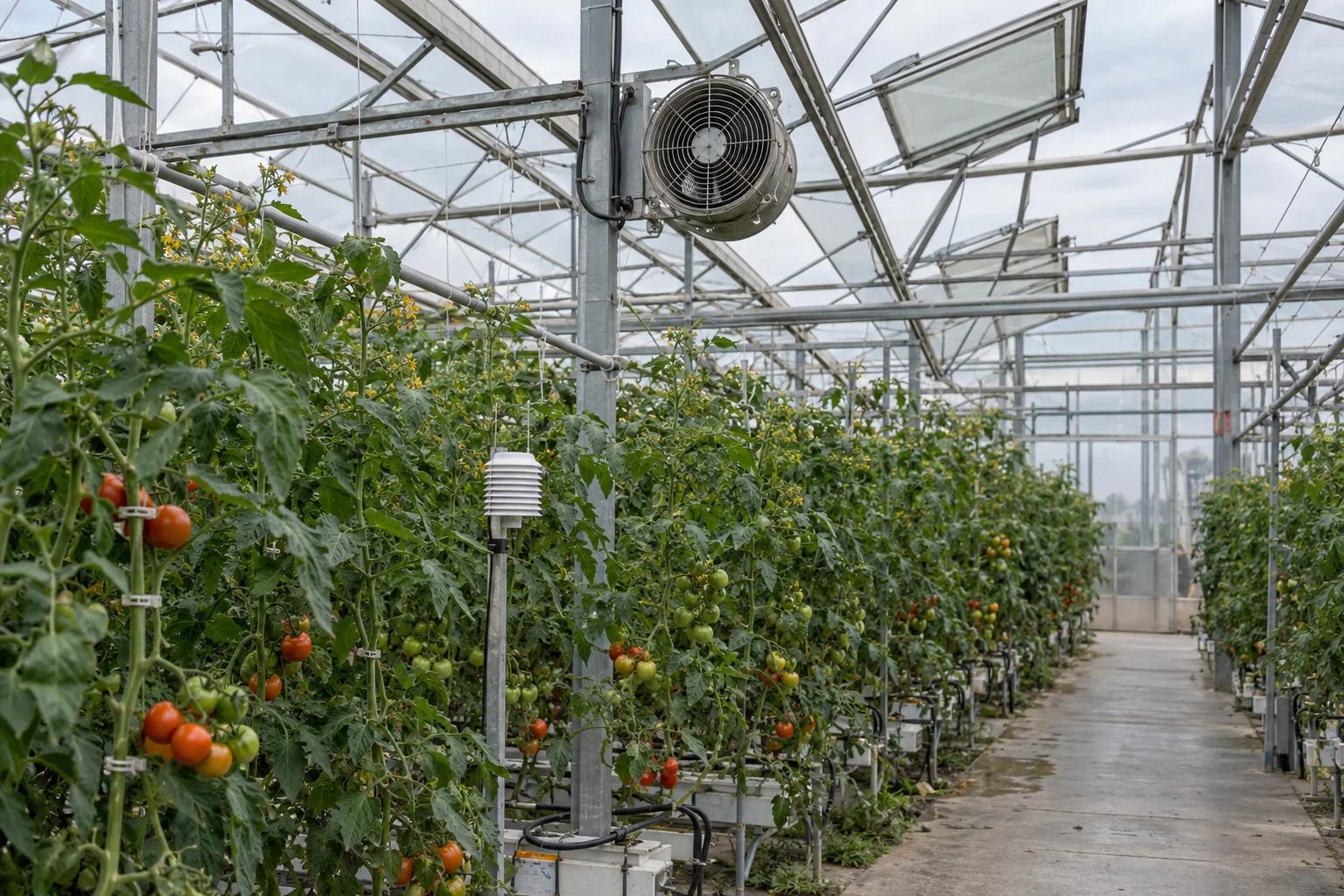
Greenhouse ventilation is a controlled exchange with outdoor air. It must remove unwanted heat or moisture while respecting the crop, weather and heating capacity. A running fan is not proof of fresh-air exchange, and an open vent is not proof of an acceptable climate throughout the canopy. Start with the airflow path and verify its result.
Separate three functions
Air exchange, circulation and active cooling solve different parts of the problem.
Compare moisture correctly
Indoor and outdoor relative humidity alone do not show the drying potential.
Measure at crop level
Check spatial differences and control response under a representative crop load.
Draw the air path before choosing equipment
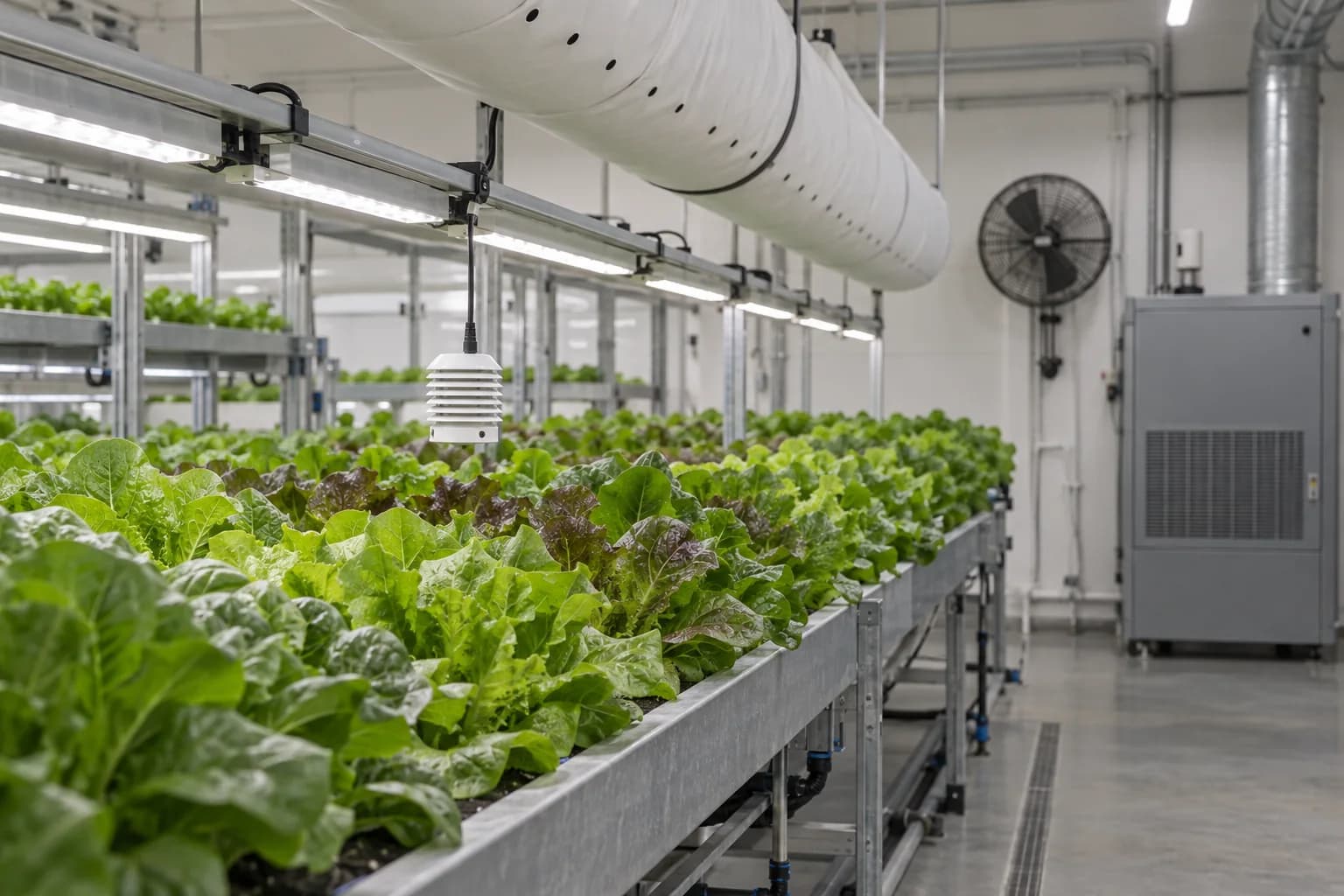
Mark the outdoor inlet, route through the crop and exhaust or roof outlet. Natural ventilation relies on wind and temperature differences; fan ventilation adds a driven flow through specified openings. Circulation mainly redistributes air already inside. UMass explains the distinction and the importance of inlet and fan sizing. Ventilation guidance. Record the greenhouse geometry, neighbouring structures, insect screens and normal crop height. A fan’s catalogue airflow does not describe installed performance against screens, shutters and other resistance.
Air exchange and circulation are separate paths
- Outdoor inlet
Check available opening and screens.
- Crop zone
Compare conditions inside the canopy.
- Roof outlet
Record opening and weather constraints.
- Circulation
Check mixing separately from fresh-air exchange.
Check what happens when the weather changes
An opening that works with one wind direction may perform differently in still air or a storm. Review wind, rain and low-temperature limits with the vent supplier and crop manager. In Hamfy’s proposed control sequence, weather protection limits the permitted opening, while crop temperature and humidity determine the demand inside that boundary. Log requested and actual vent positions where feedback exists. A command without movement should generate an equipment check. Define how the crop is protected when weather constraints prevent sufficient ventilation.
Treat sunny-day overheating as a heat-balance problem
Record radiation, outdoor temperature, shading state and temperatures at several crop positions before increasing fan speed. Ordinary air exchange has limited cooling potential when outdoor air is already hot. Compare shading, ventilation and, where appropriate, an engineered cooling system as interacting measures. UMass discusses this limit and the dependence of evaporative cooling on outdoor conditions. Cooling context. Do not infer delivered airflow from motor power alone. Confirm inlet opening, maintenance condition and airflow distribution, then assess how quickly the crop zone recovers after a controlled adjustment.
Use moisture content and dew point for winter decisions
Relative humidity changes with temperature. Cool outdoor air at high RH may still contain less water vapour than warmer greenhouse air. Heating that air lowers its RH but does not itself remove water. Condensation risk also depends on the temperature of leaves and other surfaces. Humidity principles. Compare humidity ratio at the same pressure and observe representative leaf or surface temperatures. Coordinate heating and ventilation so that moisture removal does not push the crop below its permitted temperature.
Worked psychrometric example at 101.325 kPa: indoor air at 20 °C and 85% RH has a humidity ratio of about 12.4 g/kg of dry air. Outdoor air at 5 °C and 90% RH is about 4.9 g/kg. The difference indicates drying potential despite the higher outdoor RH. This is not a ventilation-rate calculation: crop transpiration, infiltration, heat loss and equipment limits still determine the required action.
Higher RH does not always mean more moisture
| Assumed air state | Relative humidity | Humidity ratio |
|---|---|---|
| Indoors · 20 °C | 85% | 12.4 g/kg |
| Outdoors · 5 °C | 90% | 4.9 g/kg |
Put the measurement where the decision matters
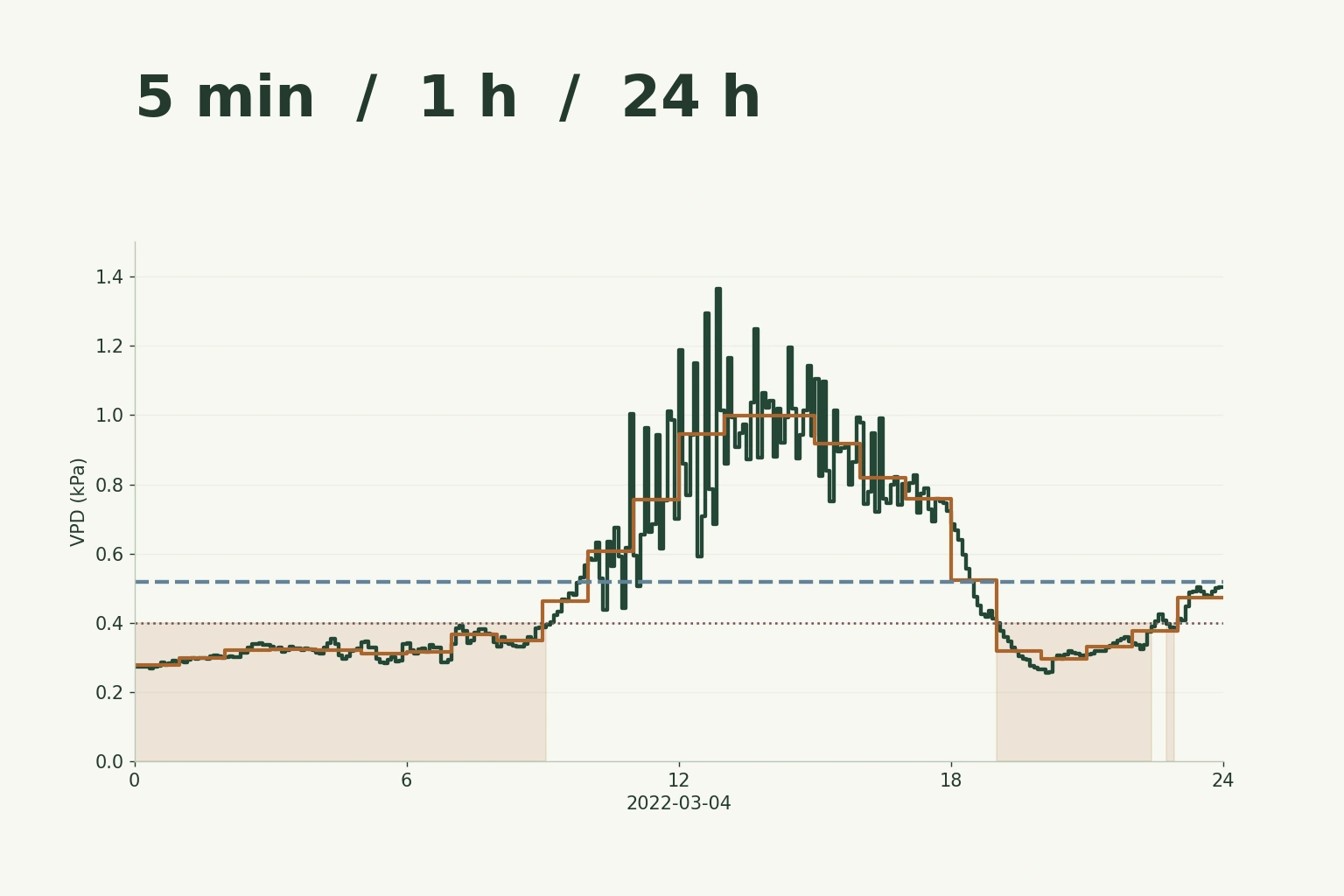
Use a representative crop-height air sensor protected from direct radiation and irrigation, with appropriate aspiration where required. Compare additional points near inlets, the far end and dense canopy zones during commissioning. Record time, height and position, not just a sensor number. A central average can hide a cold edge or a warm stagnant bay. UMass describes how air circulation reduces spatial temperature differences. Circulation guidance. Pair local observations with our VPD analysis and inspect short episodes as well as daily summaries.
Coordinate vents, fans, screens and heating
Write a sequence the operator can explain: which demand acts first, what limits it, and when another device may intervene. Agree deadbands, minimum run times and recovery periods with the designer so equipment does not repeatedly reverse or fight itself. State how screens alter the air route, how CO₂ enrichment interacts with vent opening, and who can override a setting. Include high-temperature and power-failure alarms with an assigned response. Verify actual actuator behaviour before adding predictive or AI control to the sequence.
Commission the greenhouse with a crop and a record
Choose representative sunny, cool-humid and weather-limited periods. Record outdoor conditions, crop-stage information, temperature, RH, vent position, fan state and heating demand on a common time base. Compare excursions, recovery time, spatial spread and measured energy against agreed acceptance criteria. Change one planned part of the sequence and repeat under comparable conditions. Hamfy proposes this evidence as the basis for an upgrade: improved uniformity or fewer wet-leaf episodes should be demonstrated separately from any claimed yield benefit. The sensor-data analyser can help inspect exported logs.
Common questions
Is a circulation fan enough to ventilate a greenhouse?
No. It mixes indoor air. Fresh-air exchange requires a route between inside and outside, through vents or an intake-and-exhaust system.
Can ventilation dry a greenhouse when outdoor RH is higher?
Yes, if the outdoor air has a lower humidity ratio. Compare temperature and moisture together, and account for the heat needed to maintain crop conditions.
Can one thermostat control the whole process?
It can provide basic temperature control, but it does not by itself assess canopy humidity, weather limits, actuator faults or interactions with heating and screens.
Sources & research
Primary sources selected for this article. Reviewed by Hamfy on .
Evidence brief: verifying greenhouse ventilationRead the research brief · scope, findings and limitations- Research / technical guidance · 2005Ventilation for GreenhousesJohn W. Bartok, Jr. · UMass Extension
University engineering guidance on ventilation, fan systems and cooling limitations. Sizing examples are contextual rules of thumb.
- Research / technical guidance · n.d.Reducing Humidity in the GreenhouseUMass Extension / University of Connecticut
University explanation of humidity and condensation; used for physical principles, not a universal crop recipe.
- Research / technical guidance · 2010Greenhouse Best Management Practices Manual · Horizontal Air FlowUMass Extension
University guidance on circulation and temperature uniformity within the greenhouse.
Have a correction or additional project evidence? Contact the Hamfy team.
Turn a growing problem into a measurable brief.
Bring your room layout, crop programme and existing records. We can discuss the sensors, controls and evidence needed for your next step.