Grow Room Humidity at Night: Causes, Condensation and Control
Why humidity rises after grow lights switch off, how to calculate dew point and what to check before changing ventilation or dehumidifier settings.
Explore the guide
A humidity spike after lights-off can come from cooling, continued moisture release or both. Read temperature and relative humidity together, then compare dew point with cold surfaces. Turning up a circulation fan alone does not remove the water from the room.
Temperature changes the reading
Relative humidity can rise even when the water vapour in the air stays constant.
Find the cold surface
Condensation depends on surface temperature, not only the room's average RH.
Verify moisture removal
Check whether ventilation or dehumidification actually removes water under night conditions.
Why does humidity rise when grow lights turn off?
Less heat from lighting can reduce air and leaf temperatures. Cooler air has a lower saturation vapour pressure, so its relative humidity rises at the same actual vapour pressure. The crop, wet surfaces and irrigation may add moisture as well. The FAO vapour-pressure equations let us separate the cooling effect from assumptions about new moisture. A high RH value alone cannot tell you which mechanism dominated.
An example: 24°C and 60% RH becomes nearly 87% RH
Start with air at 24°C and 60% RH. If its actual vapour pressure stays fixed and it cools to 18°C, RH reaches about 86.7%. Dew point remains about 15.8°C. A surface at 15°C can therefore collect condensation even while the room air is warmer. This is an idealised calculation, not a measured grow-room event: ventilation, transpiration and moisture removal are deliberately excluded.
Cooling alone can create a night-time RH spike
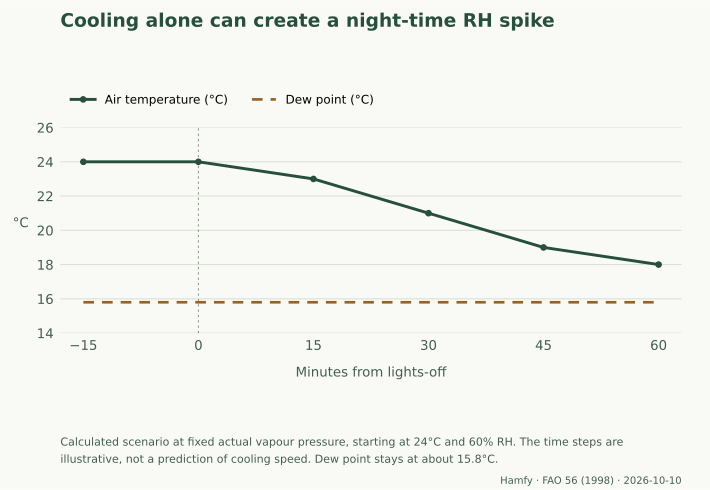
Minutes from lights-off
| Minutes from lights-off | Air temperature (°C) | Dew point (°C) | Relative humidity (%) |
|---|---|---|---|
| -15 | 24 | 15.8 | 60 |
| 0 | 24 | 15.8 | 60 |
| 15 | 23 | 15.8 | 63.7 |
| 30 | 21 | 15.8 | 72 |
| 45 | 19 | 15.8 | 81.5 |
| 60 | 18 | 15.8 | 86.7 |
Measure where the crop and equipment are
Log paired temperature and RH at canopy height and near representative cold or poorly mixed zones. Keep probes out of direct sprays and radiant heat; follow their installation instructions. Compare timestamps with lights, irrigation, fans and dehumidifier status. Environmental measurement guidelines emphasise placement and reporting conditions. A sensor at the return duct may describe different air from a dense crop canopy. Check suspicious readings against a suitable reference sensor.
Decide whether air exchange or dehumidification can help
Circulation mixes air; it does not by itself export water. Ventilation removes moisture only when the incoming air, considering its moisture content and flow, can carry away more than is being added. Outdoor RH alone is misleading: compare dew point or humidity ratio at comparable pressure, and account for heating or cooling. Check the dehumidifier's capacity at actual night temperature and RH, its operating limits, drain and defrost behaviour.
A practical order for a night-humidity check
- 01Confirm the reading
Check paired temperature/RH, placement, calibration and timestamps.
- 02Check condensation risk
Compare dew point with the coldest relevant surfaces.
- 03Find the moisture path
Inspect crop load, irrigation, air exchange, condensate drainage and equipment status.
- 04Repeat and compare
Change one justified setting and assess the next comparable nights.
Treat the transition as a control problem
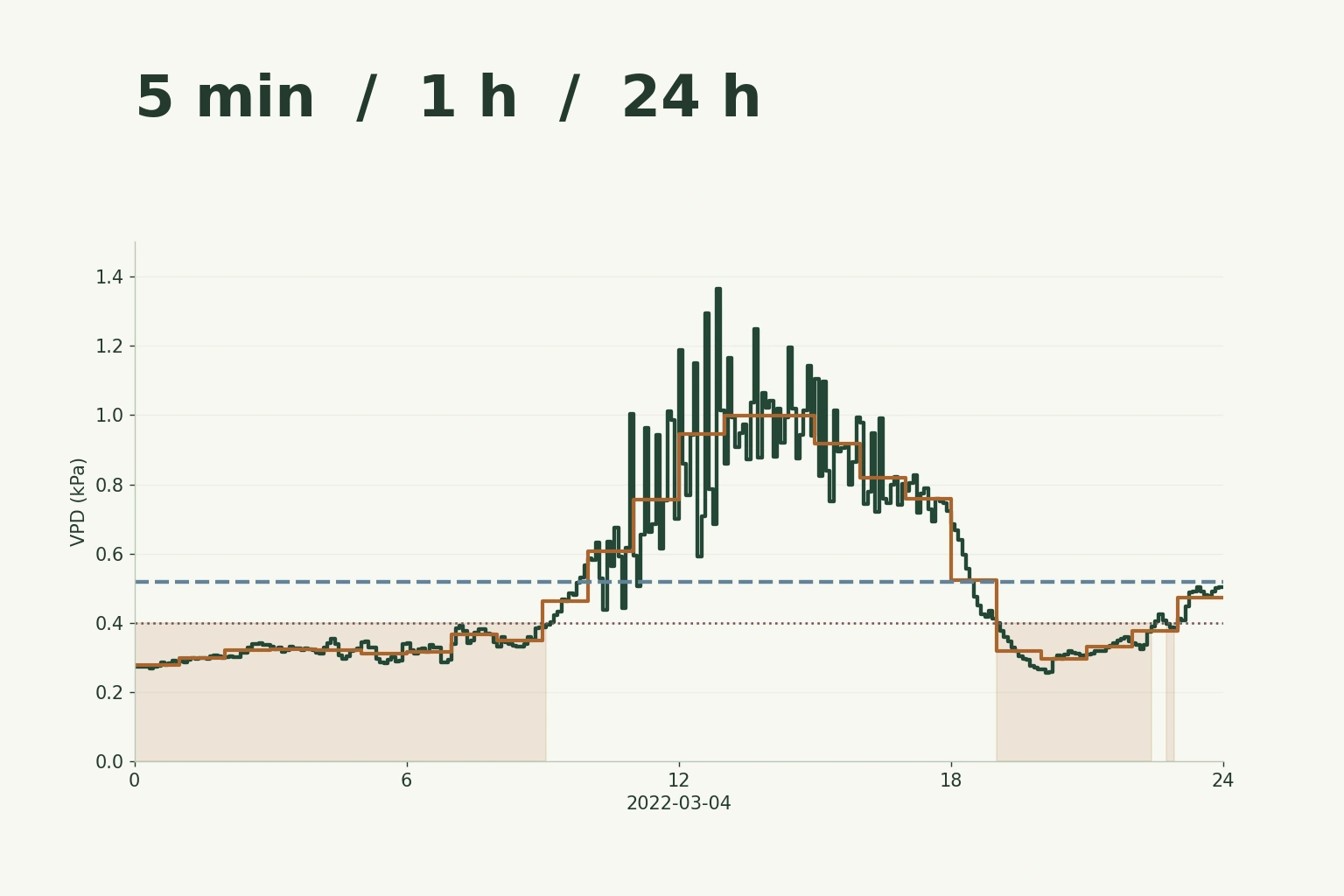
Inspect the period before and after lights-off rather than just the daily average. Check whether cooling and moisture-removal setpoints conflict, and whether the system cycles off while the crop keeps adding water. The VPD perspective also helps interpret air conditions without treating RH as an independent variable. Test one justified adjustment at a time; preserve the required crop photoperiod. Avoid solving one RH alarm by overheating or overdrying the crop.
Define success beyond one lower RH value
Compare repeated nights under similar crop load and outdoor conditions. Track peak RH, dew point, time spent near condensation, leaf or surface temperatures where available, and equipment runtime. Document sensor uncertainty when a surface is close to dew point. Use our VPD calculator for context and the broader dehumidification guide for system planning. Air VPD alone does not prove that every leaf or duct stayed dry.
Common questions
Can RH rise without adding water to the air?
Yes. Cooling raises relative humidity at the same actual vapour pressure. Real rooms can also gain moisture from plants and wet surfaces.
Will a circulation fan solve night humidity?
It can reduce local differences, but moving air around a closed room does not remove its water. Moisture must leave through air exchange or a removal process.
Does a dehumidifier's headline litres per day guarantee night performance?
No. Capacity depends on inlet conditions and equipment design. Compare the rating conditions with your night temperature and RH and check actual operation.
What is the safest humidity setting at night?
There is no single value for every crop and room. Consider crop requirements, surface temperatures, disease risk, sensor uncertainty and the system's ability to control moisture.
Sources & research
Primary sources selected for this article. Reviewed by Hamfy on .
Evidence brief: separating cooling from moisture at lights-offRead the research brief · scope, findings and limitations- Technical source · 1998Crop evapotranspiration — Guidelines for computing crop water requirements · Chapter 3FAO · Irrigation and Drainage Paper 56
Basis for saturation vapour pressure, actual vapour pressure and the dew-point calculation. It is not a grow-room control recipe.
- Technical source · 2015Guidelines for measuring and reporting environmental parameters for experiments in greenhousesBoth et al. · Plant Methods
Supports careful sensor placement and reporting of environmental measurement conditions.
- Technical source · 2015Why should greenhouse growers pay attention to vapor-pressure deficit and not relative humidity?Michigan State University Extension
Explains why temperature and RH should be interpreted together through vapour-pressure deficit.
Have a correction or additional project evidence? Contact the Hamfy team.
Turn observations into useful decisions
Discuss a monitoring plan with Hamfy: what to measure, where to measure it and which evidence an alert should trigger.