Button mushroom cultivation: compost, casing and climate control
How Agaricus bisporus production connects prepared compost, the casing layer, pin formation and harvest flushes with measurements inside the growing room.
Explore the guide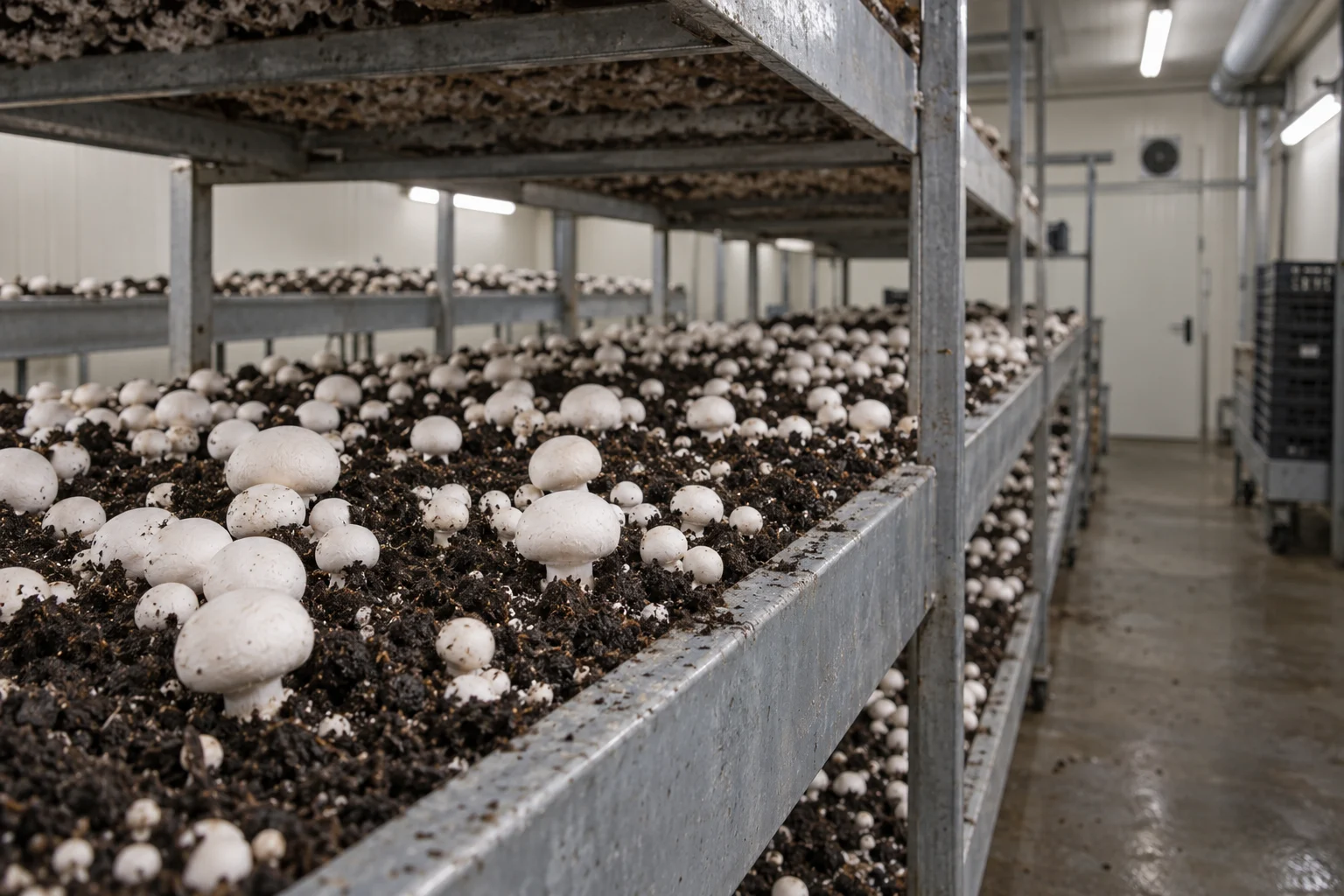
A button mushroom room is built around a living compost system and a separate casing layer. Controlling air temperature alone misses the processes beneath the surface. Understanding what arrives from the substrate supplier is the starting point for a useful crop plan.
Know the compost phase
The delivered material determines which production stages remain on the farm.
Keep two temperatures
Compost temperature and air temperature answer different questions.
Manage the flush
Pin distribution, water and harvest timing interact with the room climate.
Start with the delivered compost
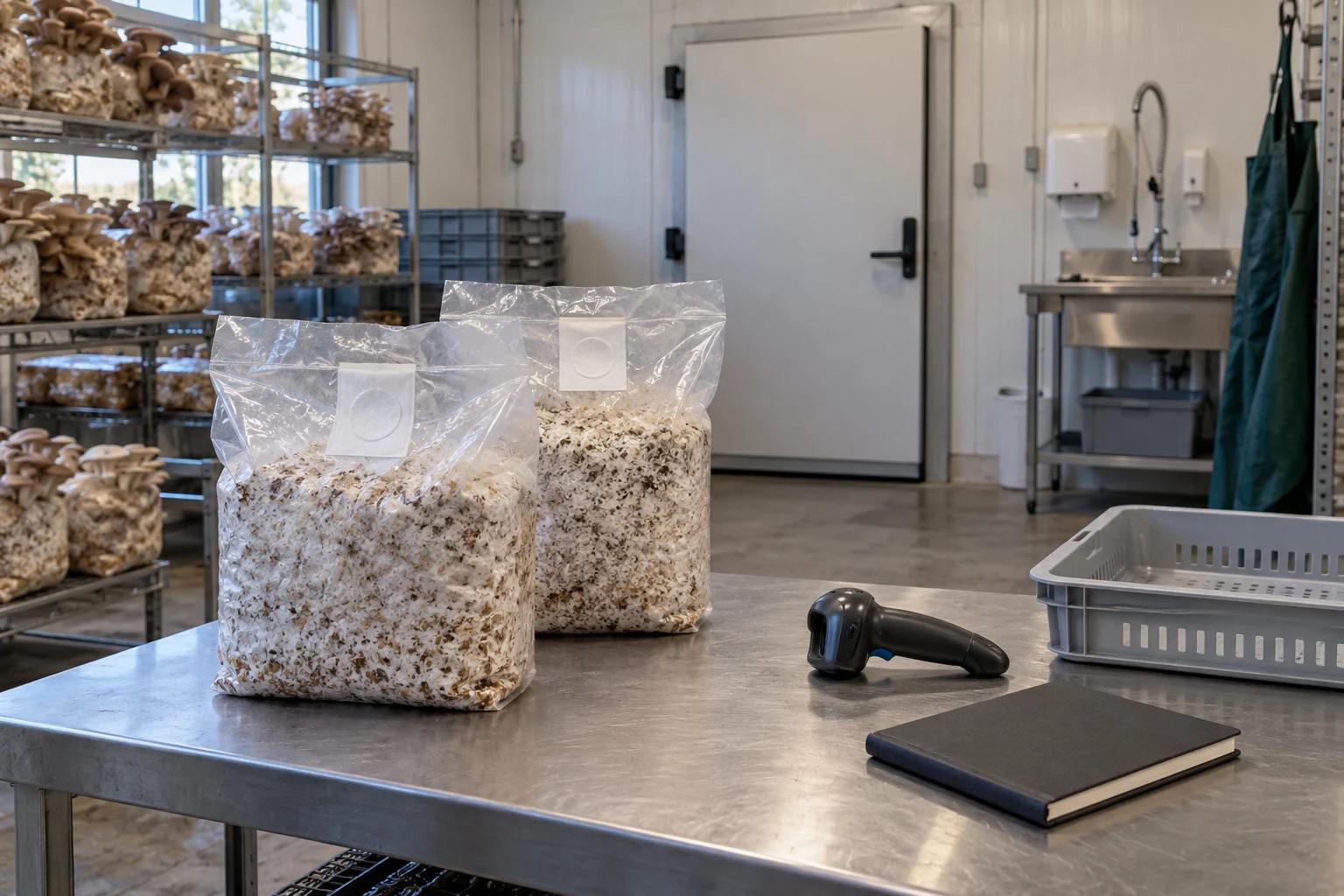
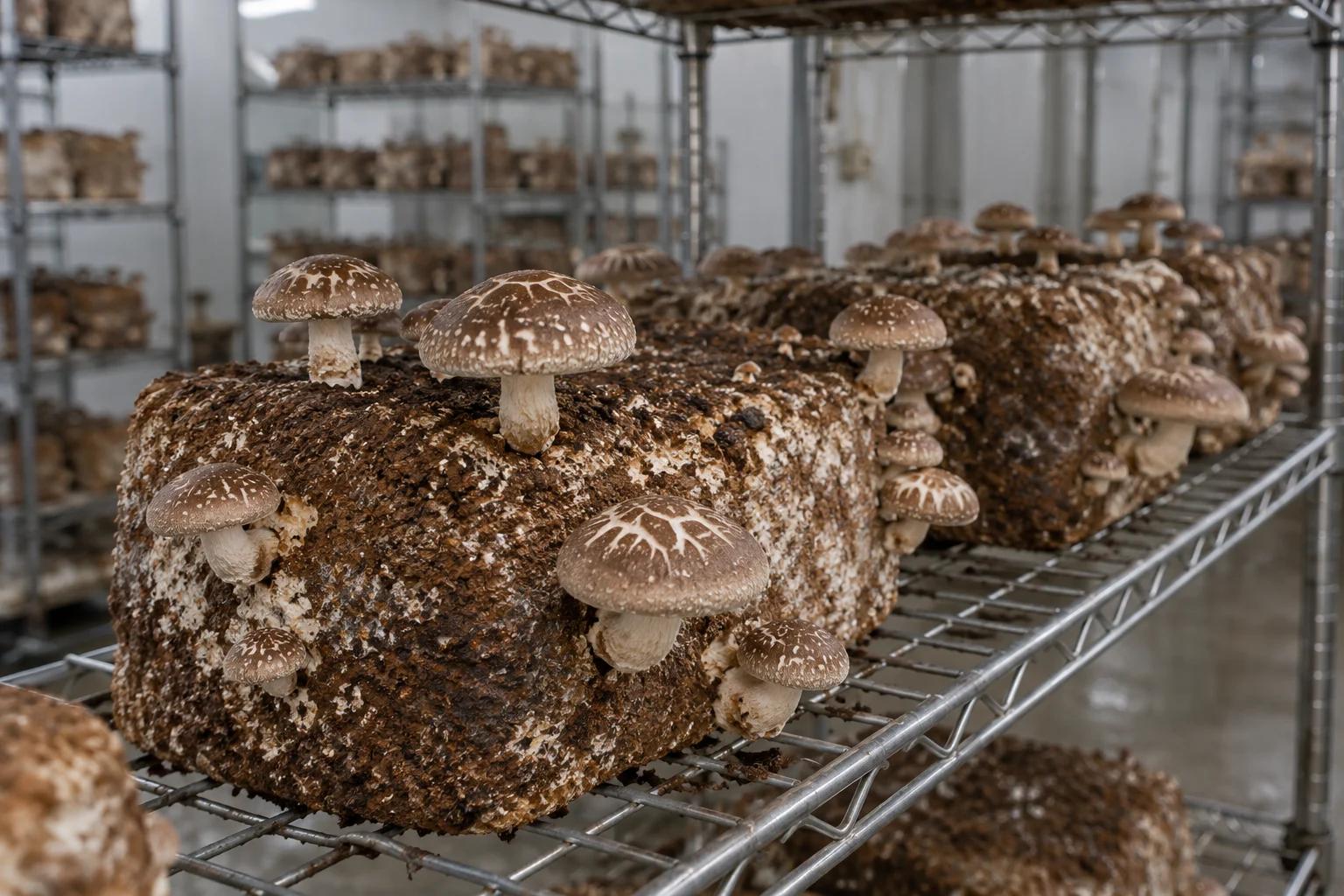
Agaricus bisporus is cultivated on prepared compost rather than the same wood-based block used for shiitake. Phase I develops the compost; Phase II includes pasteurisation and conditioning; Phase III includes colonisation by mushroom mycelium. Confirm the actual product with the supplier. Receiving Phase III compost shifts work upstream but does not remove the need to check delivery condition, filling consistency and handling. Teagasc describes specialised substrate suppliers linked to growing farms. Production context.
The casing is a separate working layer
Casing covers colonised compost and provides a water reservoir and conditions supporting fruiting. Treat its depth, structure, moisture and application as recorded variables. Uneven application can make two parts of a bed behave differently despite identical air readings. A casing problem is not fixed simply by raising the room's humidity. Penn State explains how compost, casing and the developing crop form a connected system. Agaricus production stages.
Three levels of the same crop
| Level | Observe | Record separately |
|---|---|---|
| Room air | Temperature, RH, CO₂, air distribution | Sensor position and control programme |
| Casing and surface | Water distribution, pins, visible changes | Watering time, bed zone and crop stage |
| Compost | Temperature, fill and colonisation | Supplier batch, depth and probe position |
Read air and compost temperatures together
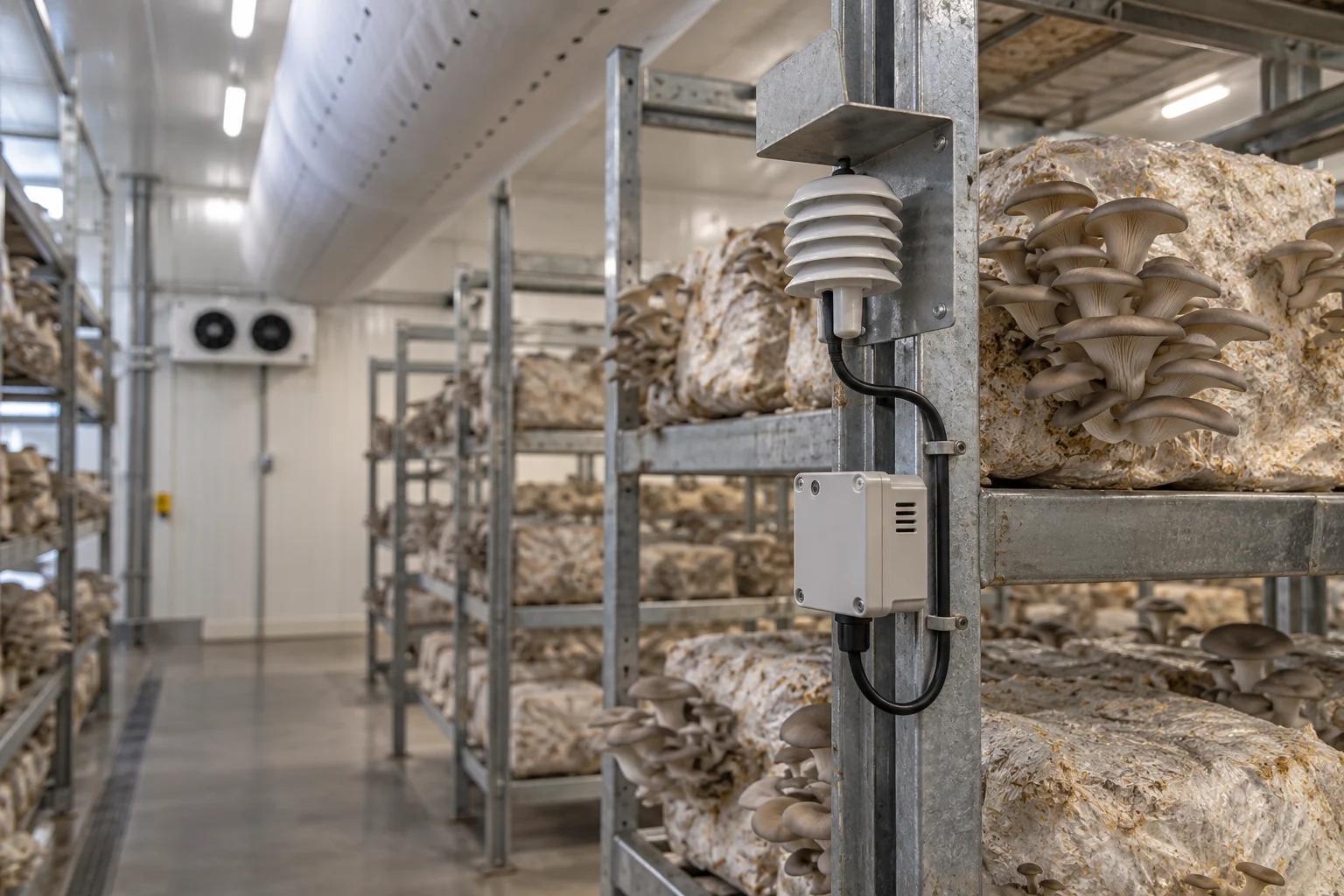
Mycelial growth produces heat. Record the temperature of representative compost zones alongside room air, and retain probe position and insertion depth. A hot region can be hidden by an average of several beds. Check loading, distribution and actual sensor readings before increasing cooling everywhere. Penn State's substrate guidance describes the interaction of growth, heat and moisture; the appropriate response depends on the stage and compost. Substrate management.
Pinning is a controlled transition
Pinning establishes the young mushrooms that will develop into a flush. Changes in air conditions and CO₂ participate in that transition, but the crop's readiness also matters. Use the supplier and grower's phase-specific programme, document when it starts, and inspect the resulting distribution of pins. A sudden programme change on an uneven bed can increase variability. Record water applications and crop stage together rather than interpreting a humidity graph in isolation.
Uniform air is a question to measure
A study by Sabeh and colleagues compared three air-distribution layouts in small commercial-design Agaricus rooms. Layout affected spatial temperature and humidity. The most uniform arrangement did not produce a corresponding improvement in yield or quality in that experiment. The practical lesson is to map the room and measure harvest outcomes separately; even a well-supported engineering improvement is not automatically a production gain. Primary room study.
Evaluate each flush and the room turnaround
For every flush, keep marketable and rejected weights, size grades, picking hours and bed area. Compare like-for-like compost loads and crop durations. Decide on an additional flush using quality, expected contribution, disease observations and the next filling date. After crop removal, cleaning and any validated treatment belong in the turnaround record. Hamfy's proposed dashboard connects those events with temperature and ventilation histories; it does not prescribe a compost formulation or guarantee extra yield.
Common questions
Are white buttons and portobello different species?
They are commercial forms of Agaricus bisporus. Strain, colour and harvest maturity differ; their crop and market specifications should still be explicit.
Can the air sensor replace compost probes?
No. The substrate can generate heat, and one air reading does not establish conditions within the compost.
Does more uniform climate guarantee higher yield?
No. The cited room study did not show a matching yield improvement. Evaluate uniformity, quality and output as separate outcomes.
Sources & research
Primary sources selected for this article. Reviewed by Hamfy on .
Evidence brief: measuring an Agaricus growing roomRead the research brief · scope, findings and limitations- Research / technical guidance · n.d.Basic Procedures for Agaricus Mushroom GrowingPenn State Extension · David M. Beyer
Cultivation stages and the separate roles of compost and casing. Numerical recipes are not reproduced as universal targets.
- Research / technical guidance · n.d.Seeding Substrate and Management of Growing Agaricus BisporusPenn State Extension
Growth, substrate heat and moisture management.
- Research / technical guidance · 2020Mushroom ProductionTeagasc
Description of the commercial growing-room and substrate-supplier system.
- Research / technical guidance · 2006Environmental conditions within small-scale Agaricus bisporus mushroom production roomsSabeh et al. · Applied Engineering in Agriculture
2006 primary experiment; spatial uniformity and crop outcomes are kept distinct.
Have a correction or additional project evidence? Contact the Hamfy team.
Make your mushroom room easier to understand.
Discuss the measurements, cameras and operating records your facility needs. Start with a defined problem and an observable outcome.