Mushroom farm contamination: prevention, monitoring and batch traceability
Build a practical contamination workflow around receiving checks, hygiene, surface moisture, traceable observations and comparable batch records.
Explore the guide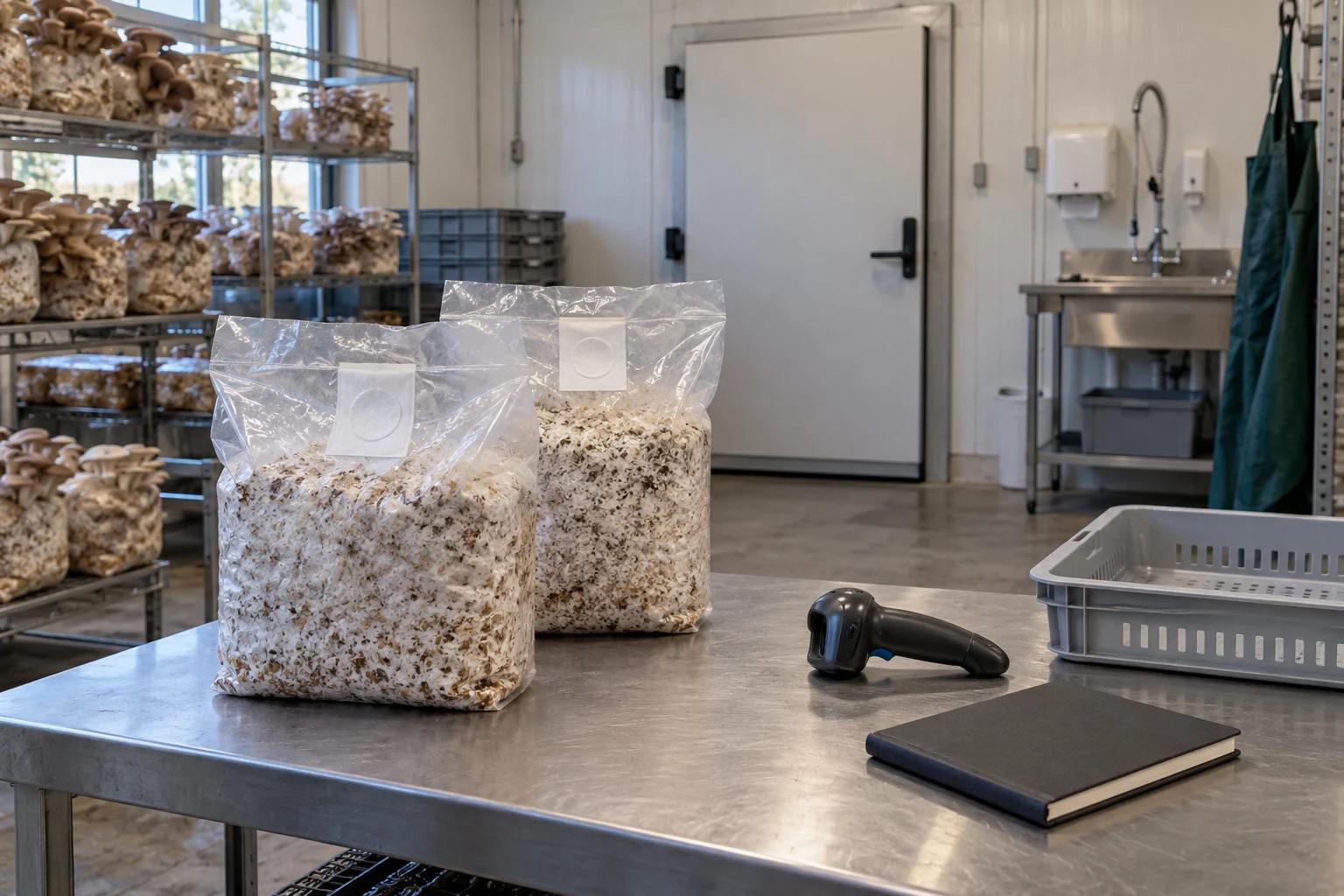
Contamination management begins before a visible patch appears. A useful system reduces avoidable transfer, recognises changes early and preserves the evidence needed to investigate. It also keeps crop disease, food-safety findings and ordinary process variation from becoming one undifferentiated alarm.
Record before mixing
Preserve supplier, batch and room identity from receipt to dispatch.
Clean before disinfecting
Debris and the choice of process affect whether hygiene measures work.
Separate observation from finding
A camera flag is not organism identification or product-release approval.
Define what the problem actually is
Green mould in substrate, bacterial spotting on caps and a microbiological finding in a food sample are different problems. A visible change may justify action without identifying its cause. Penn State describes substantial production losses associated with Trichoderma green mould, but colour alone does not identify a species. Record the observed material, location, time and extent first. Use crop-specialist or laboratory investigation when the identity or consequence matters. Green mould context.
Give receiving checks a lasting identity
Assign a batch identifier before blocks or compost are distributed between rooms. Record supplier lot, strain, arrival time, packaging integrity, visible abnormalities and any agreed temperature check. Photograph exceptions with a scale and location reference. Segregate material that fails the receiving specification according to the farm's procedure, and preserve the supplier communication. These are Hamfy's proposed traceability fields: the aim is to distinguish an incoming issue from one that develops after handling, not to assume the supplier caused it.
Control movement, debris and shared equipment
Map the route of new substrate, people, harvest containers and spent material. Avoid carrying debris from older or suspect crops into new production. Make tools, cleaning equipment and work order part of the plan rather than relying on a doorway sign. Teagasc's hygiene guidance explains why physical cleaning must precede disinfection and why disinfectant alone is not a complete disease-management system. Select products and procedures appropriate to the actual use and current authorisation; this guide provides no chemical treatment recipe. Hygiene principles.
Link water events with surface observations
A high RH value is not the same as water remaining on a cap. Bacterial blotch guidance describes the importance of persistent surface moisture and spread through splashing and equipment. Log watering, humidifier faults, condensation observations and drying behaviour separately. If spotting appears on one shelf, compare its surface conditions and handling history with unaffected areas. Do not infer an organism solely from a coincident humidity peak. Bacterial blotch.
Use a repeatable inspection and response sequence
Inspect comparable locations at defined stages, adding checks after a recorded exception. Save an overview and a close view under consistent lighting, without disturbing suspect material merely to obtain a better image. Mark the finding's status as observed, under review or confirmed. Have a responsible person decide containment, sampling and the next action under the farm's procedure. Teagasc's integrated guidance combines inspections with hygiene and management of transmission routes. Integrated prevention.
A camera can help document where and when a visible change appeared. A model can prioritise review only within its demonstrated performance. Neither establishes absence of contamination in unseen material. If a sample is sent to a laboratory, retain its identifier, sampling location, collection time, method requested and report. Keep a food-product decision with the qualified food-safety process rather than letting an image score release a batch.
Minimum record for an actionable observation
| Field | Capture | Why it matters |
|---|---|---|
| Identity | Batch, supplier lot, room and rack | Connect affected and unaffected material |
| Observation | Time, crop stage, image and extent | Preserve what was actually seen |
| Context | Watering, handling and climate events | Build a sequence without assuming cause |
| Decision | Owner, action and sample reference | Make the response traceable |
| Review | Result, uncertainty and next check | Avoid closing on an unverified assumption |
Compare batches using stable denominators
Count rejected blocks against blocks received, not only against those that survived to harvest. For bed systems, define the inspected area and sampling approach. Track marketable weight, reason-coded losses, occupied days and labour alongside environmental events. Worked example: 12 rejected blocks out of 200 received is 6%; 12 out of the 188 remaining is about 6.4% and answers a different question. Neither percentage is a laboratory-confirmed disease prevalence unless the case definition and sampling support that claim.
Close the investigation with evidence
Choose a specific hypothesis: receiving damage, a handling route, persistent wetness or a room-control fault. Preserve the timeline, make an agreed correction and compare subsequent batches using the same definitions. Several changes at once make attribution difficult; a before-and-after improvement alone does not establish causation. Hamfy's proposed workflow closes with the responsible person's review, unresolved questions and the next check. Pair it with the climate guide to connect events and measurements without turning correlation into a diagnosis.
From first observation to a reviewed outcome
- 01Observe
Describe the change and preserve its location
- 02Contain and assess
Follow the farm's procedure and assign responsibility
- 03Investigate
Connect history, sampling and expert findings
- 04Review
Check the outcome and update the process
Common questions
Can an image prove that a block is free from contamination?
No. It only records visible features at one time and viewpoint. Hidden or early contamination may not be visible.
Is every brown shiitake block a warning?
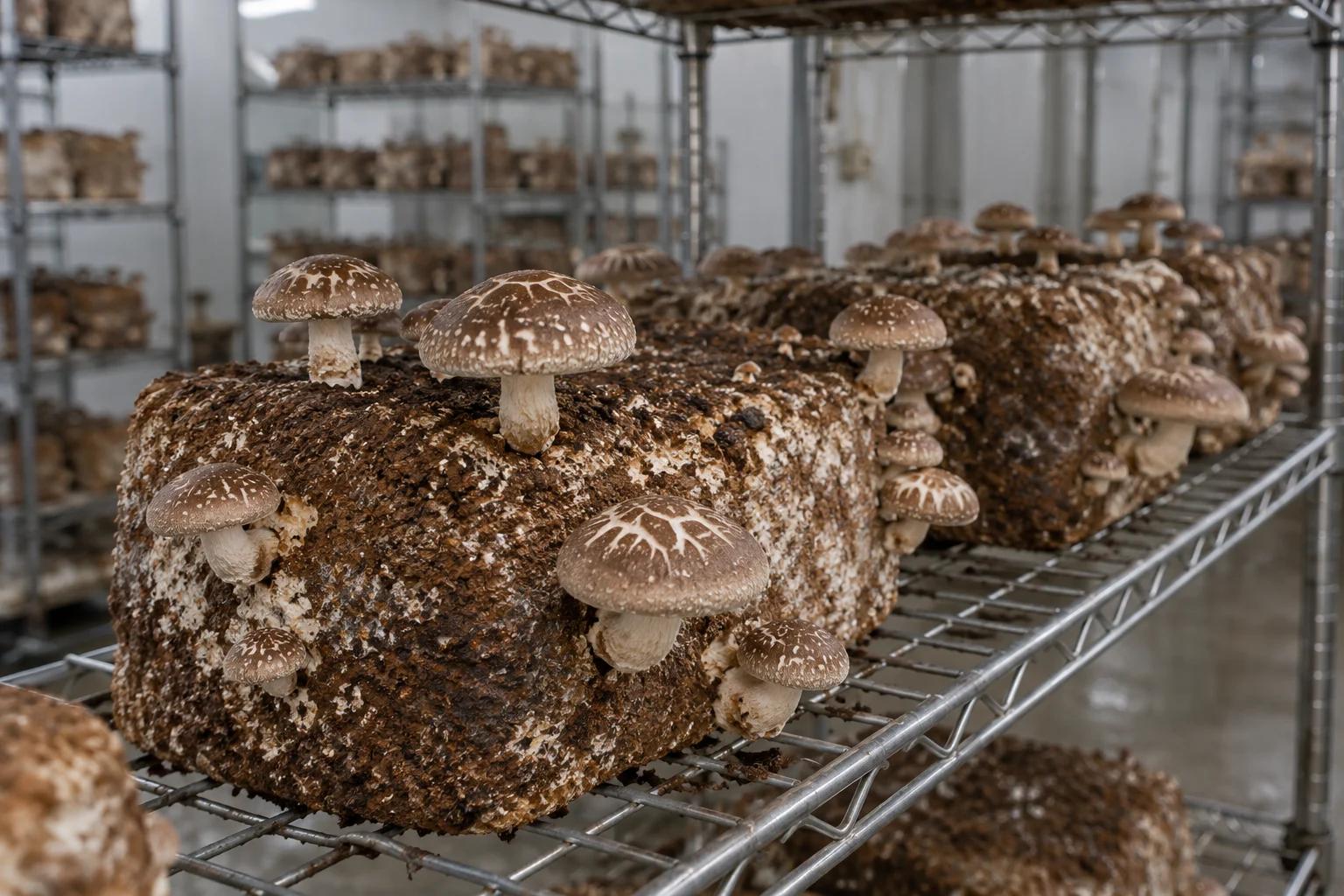
No. Browning is a normal maturation stage. The species and development history must be included before interpreting colour changes.
Does a negative laboratory sample clear an entire batch?
Not by itself. Its meaning depends on the sample, method, reporting limits and the agreed sampling and decision plan.
Sources & research
Primary sources selected for this article. Reviewed by Hamfy on .
Evidence brief: a traceable contamination investigationRead the research brief · scope, findings and limitations- Research / technical guidance · n.d.Green Mold of MushroomsPenn State Extension
Crop-disease context for Trichoderma; not identification from colour alone.
- Research / technical guidance · n.d.Bacterial Blotch DiseasePenn State Extension
Surface moisture and transmission context for bacterial blotch.
- Research / technical guidance · 2015Use of chemical disinfectants in mushroom productionTeagasc / AHDB
Cleaning and disinfection principles. Historical product details are not current treatment recommendations.
- Research / technical guidance · 2015Fungal diseases of mushrooms and their controlNancy Pyck · INAGRO / Helen Grogan · Teagasc
Integrated hygiene, inspection and transmission-route management for mushroom crops.
Have a correction or additional project evidence? Contact the Hamfy team.
Make your mushroom room easier to understand.
Discuss the measurements, cameras and operating records your facility needs. Start with a defined problem and an observable outcome.