Mushroom fruiting room climate control: CO₂, humidity and airflow
A deeper guide to fresh air, condensation, sensor placement and interacting controls, including worked ventilation and dew-point calculations.
Explore the guide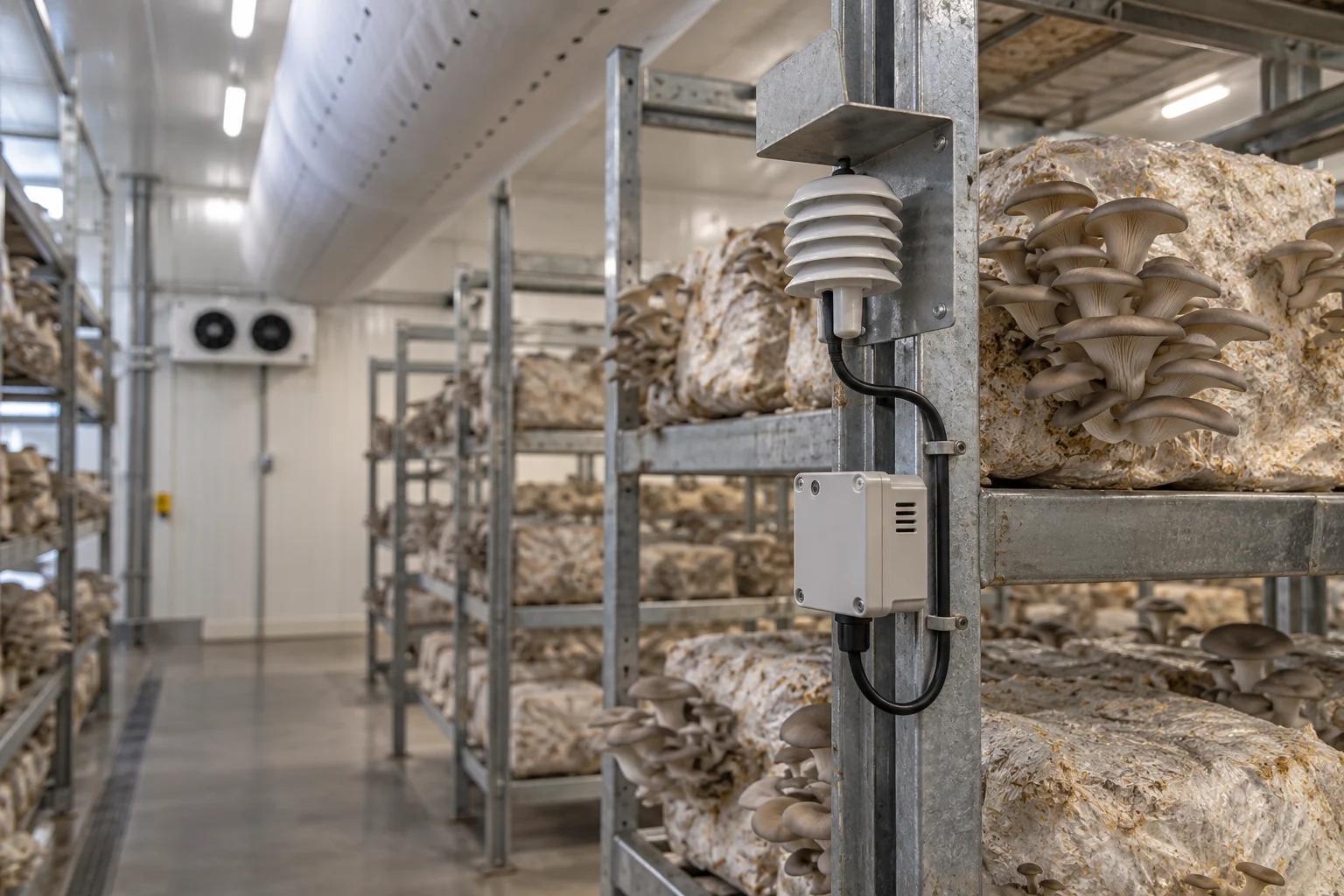
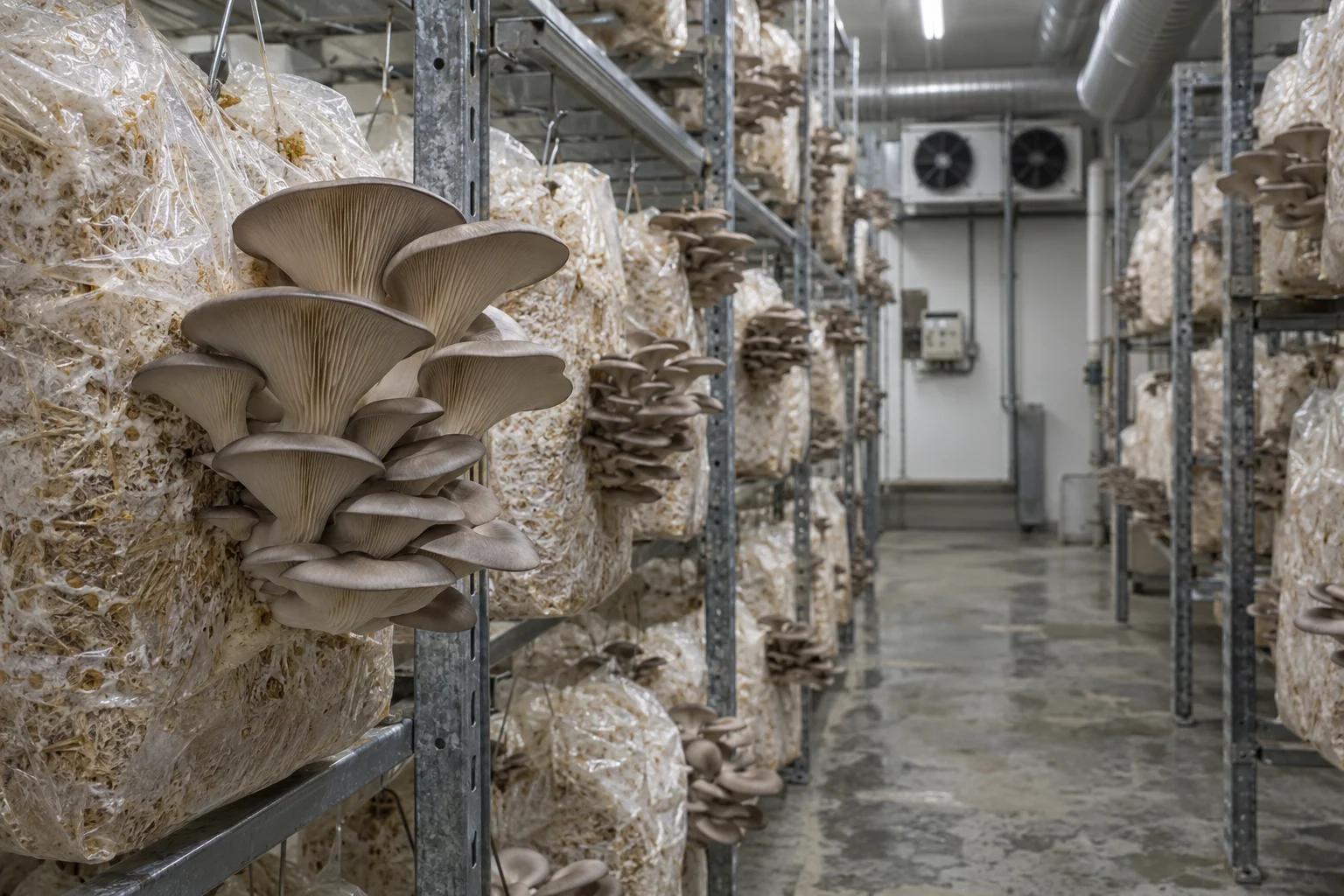
A fruiting room can show the requested humidity while exposing one shelf to a drying draft and another to condensation. Good control starts with a clear crop programme, reliable measurements and an understanding of what each actuator changes. The set point is only the beginning.
Fresh air is a separate flow
Recirculation distributes air but does not by itself remove generated CO₂.
Surfaces can be colder
Condensation depends on surface temperature and dew point, not RH alone.
Verify under crop load
An empty-room test does not reproduce a full room's heat, moisture and respiration.
Write the operating envelope before choosing equipment
Define species, strain, stage, substrate load, room volume, rack arrangement and seasonal outdoor conditions. Separate target ranges from alarms and from occupational-safety requirements. Incubation, pin initiation and cropping may need different programmes. Specify who can change a programme and how the change is recorded. Hamfy's proposed commissioning brief also lists loss-of-power behaviour, drainage, cleaning access and the measurements required to judge whether the room actually performs as intended.
Separate fresh-air removal from recirculation
A circulation fan improves mixing but does not remove the room's CO₂ source. Fresh-air exchange removes CO₂ only to the extent that replacement air has a lower concentration. A simplified steady-state, well-mixed balance is Q = G / (Croom − Csupply), with Q in m³/h, G as generated CO₂ in m³/h and concentrations as volume fractions. ASHRAE explains why using CO₂ to infer ventilation requires valid assumptions and accurate inputs. Its document is building guidance, not a mushroom set-point standard. Measurement context.
Worked example, not farm data: assume G = 0.6 m³/h, replacement air at 450 ppm and a chosen calculation point of 1,200 ppm. The difference is 750 ppm = 0.00075; Q = 0.6 / 0.00075 = 800 m³/h of replacement air. The chosen concentration is not a crop recommendation or a worker-safety limit. Actual design must account for variable respiration, imperfect mixing, heat, moisture, pressure losses and safety requirements; fan nameplate flow alone is insufficient.
Read humidity together with surface temperature
At 20°C and 90% RH, the calculated dew point is approximately 18.3°C. A surface near or below that temperature can become wet even when the room sensor has not reached 100% RH. This is an illustrative psychrometric calculation, not a growing target. Cold bridges, recently cooled surfaces and local airflow can therefore matter as much as the central RH reading. Persistent surface moisture also matters in interpreting bacterial blotch risk. Crop context.
How little cooling can reach the dew point
| Air temperature | Relative humidity | Calculated dew point |
|---|---|---|
| 20°C | 80% | 16.4°C |
| 20°C | 90% | 18.3°C |
| 20°C | 95% | 19.2°C |
Map the crop zone before fixing sensor positions
During commissioning, compare representative high and low shelves, the centre, the door side and the supply and return regions. Take measurements under representative crop loading and record location. Use the results to choose permanent control and independent checking points; do not simply put every sensor beside the controller. Sabeh and colleagues demonstrated that duct layout affected spatial conditions in Agaricus rooms. Their results justify checking distribution, not copying a duct layout without a facility assessment. Room experiment.
Compare the room before choosing permanent sensor locations
- Upper shelves
Compare crop-zone temperature, RH and CO₂ with lower levels.
- Lower shelves
Check vertical gradients and locally damp or cool areas.
- Centre aisle
Compare the room reference with measurements near the crop.
- Door side
Record disturbances from opening and movement.
- Supply and return
Check how entering and leaving air differ from the crop zone.
Make sensors survive the environment
Protect humidity probes from direct spray and droplets while preserving representative airflow. A wet probe may report saturated conditions and recover slowly, leaving a controller to act on poor information. Check operating range, condensation tolerance and the cleaning method. Vaisala explains that heated humidity probes require appropriate temperature information to derive ambient RH. Heating a probe without that compensation is not a complete measurement solution. Condensing environments.
For CO₂, confirm range, calibration procedure and reference checks. Keep sensor identity, service date, location and invalid-data flags in the log. A flat line, missing samples or an abrupt offset after cleaning should trigger a measurement check before a new crop explanation. Retain raw readings and actuator events; averages alone can hide brief excursions.
Coordinate the controls instead of making them compete
More outside air can lower CO₂ while increasing heating, cooling or humidification demand. Cooling may remove moisture, and reheating changes RH without adding water. Commission these interactions deliberately. In Hamfy's proposed control sequence, the grower's stage-specific constraints define permitted actions; deadbands, delays and minimum run times reduce rapid switching. Test the effect of one controlled change, observe recovery, then tune. Do not close ventilation to satisfy humidity if another requirement becomes unacceptable.
A control change needs a complete feedback loop
- 01Measure
Are the readings valid and representative?
- 02Act
Which constraint and actuator require a change?
- 03Observe
What happened to CO₂, heat and moisture?
- 04Verify
Did the room and crop meet the agreed outcome?
Prove performance with an agreed acceptance record
Test with representative crop load and outdoor conditions. Log air and substrate temperatures where relevant, RH, CO₂, fan and valve states, door events and crop stage. Review excursions, invalid data, gradients, energy use and recovery after disturbances. Then compare marketable harvest and losses across comparable batches. The cited airflow study found no matching yield improvement from its most uniform layout: a better climate graph is an engineering result, while a crop benefit needs its own evidence. Use the sensor-data analyser for record quality and keep the interpretation tied to the production history.
Common questions
Is there one correct air-change rate for all mushroom rooms?
No. Crop respiration, room loading, supply conditions, mixing and thermal loads vary. A nominal air-change rate also needs its fresh-air and recirculated portions identified.
Can we control condensation from RH alone?
Not reliably. Compare air dew point with relevant surface temperatures and verify that the probe itself is not wet.
Does this calculation size a complete ventilation system?
No. It explains a simplified CO₂ balance. A complete design needs measured or justified loads, duct losses, control behaviour and the facility's other requirements.
Sources & research
Primary sources selected for this article. Reviewed by Hamfy on .
Evidence brief: climate-control assumptions and calculationsRead the research brief · scope, findings and limitations- Research / technical guidance · 2006Environmental conditions within small-scale Agaricus bisporus mushroom production roomsSabeh et al. · Applied Engineering in Agriculture
Primary comparison of three air-distribution layouts, with limits on transferring the results.
- Research / technical guidance · 2019Measuring humidity in condensing environmentsVaisala · Joni Partanen
Manufacturer guidance about measurement errors and recovery in condensing environments.
- Research / technical guidance · 2025ASHRAE Position Document on Indoor Carbon DioxideASHRAE
2025 position document: limitations of CO₂-based ventilation inference, not a mushroom climate or safety standard.
- Research / technical guidance · n.d.Bacterial Blotch DiseasePenn State Extension
University explanation of surface wetness and bacterial blotch.
Have a correction or additional project evidence? Contact the Hamfy team.
Make your mushroom room easier to understand.
Discuss the measurements, cameras and operating records your facility needs. Start with a defined problem and an observable outcome.