Cannabis plant pathogens: fungi, bacteria and the meaning of a diagnosis
A clear guide to pathogen groups, visible symptoms and microbial findings in cannabis — and why an organism’s name alone does not explain a plant problem.
Explore the guide
Plant health starts with a precise question. A discoloured leaf is an observation; a suspected pathogen is a hypothesis; a laboratory finding is a result tied to a sample and a method. Treating these as interchangeable creates more certainty than the evidence supports.
Name the group
Fungi, oomycetes, bacteria and viroids are different biological groups.
Separate presence from cause
Finding a microbe is not, by itself, proof that it caused the observed damage.
Preserve uncertainty
A photograph can document a change without establishing a species-level diagnosis.
Not every plant pathogen is a fungus
Research on cannabis has documented fungi such as Botrytis and Fusarium, powdery mildew organisms and root-associated Pythium. Pythium belongs to the oomycetes, a distinct group often called water moulds. The distinction matters when reading a report: similar plant appearances can involve biologically different organisms. A published finding establishes what was observed in that study, not the frequency of that organism in every facility. Read the original investigation.
Four groups, different kinds of evidence
| Group | Examples or distinction | What the label does not establish |
|---|---|---|
| Fungi | Botrytis, Fusarium, powdery mildew fungi | The cause of an unfamiliar lesion |
| Oomycetes | Pythium; distinct from true fungi | A diagnosis from root colour alone |
| Bacteria | Plant-associated communities include endophytes | That every detected bacterium is harmful |
| Viruses / viroids | Viroids are small infectious RNA agents | That a visually normal plant is free of infection |
A visible symptom is not the same as an identified cause
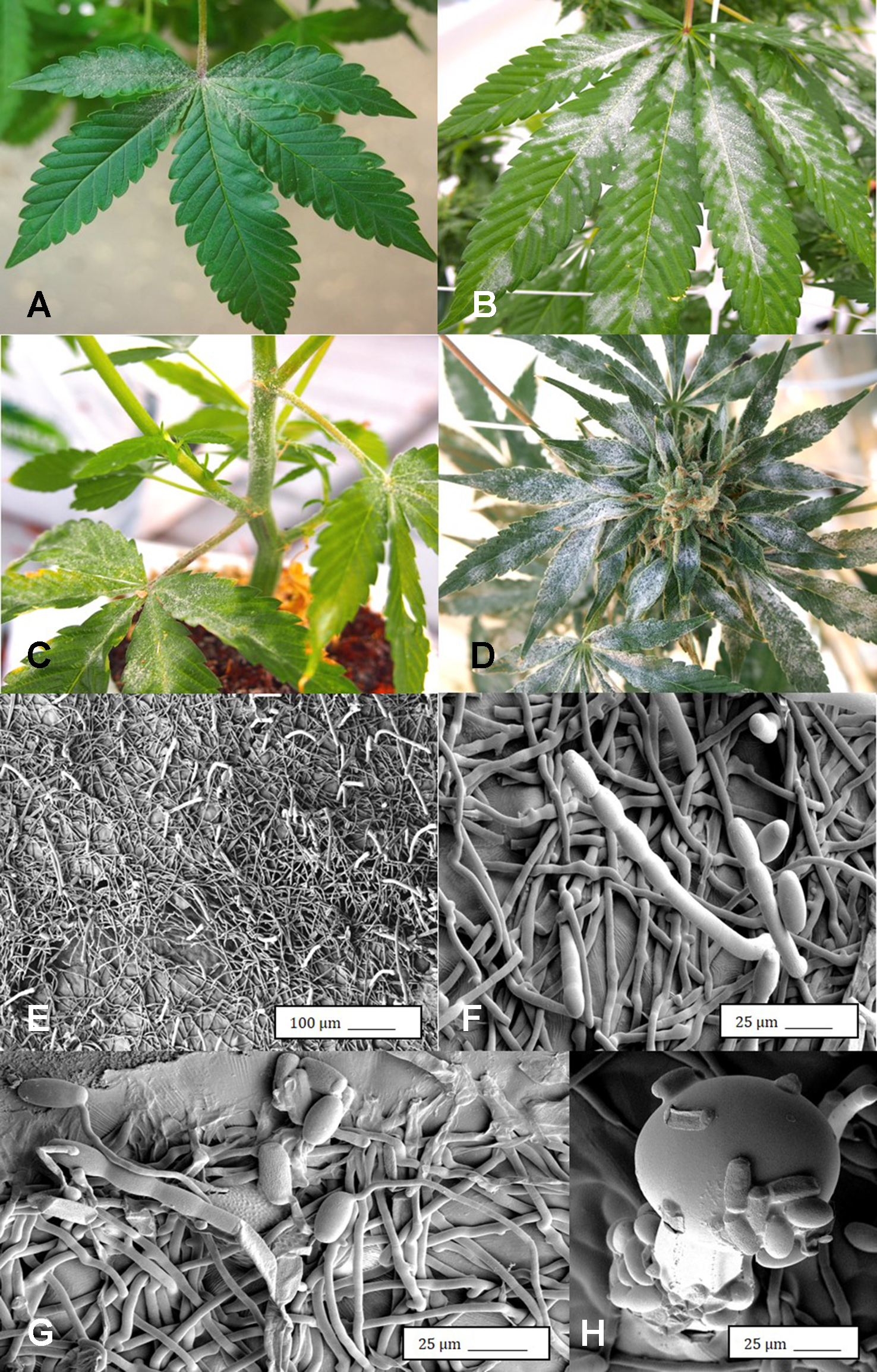
Yellowing, wilting and damaged tissue describe a plant’s appearance. They do not uniquely identify a microbe. The published figure below combines visible powdery mildew development with microscopy: these are different levels of observation. The original paper also describes uncertainty in species identification within Golovinomyces. This is a useful example of why a confident label on a leaf photograph should not imply more precision than the supporting investigation. Source and figure.
Published observations: visible signs and microscopy
Bacteria are not a synonym for disease
Plants host microbial communities. A study of cannabis seeds and seedlings recovered endophytic Bacilli and examined their activity; it does not support labelling every bacterial detection as harmful. The useful question is which organism was detected, in what material, by which method, and whether a disease-causing role was established. A community survey, a targeted test and a causal disease investigation answer different questions. The primary seed-microbiome study.
Where monitoring contributes
Our engineering interpretation is to preserve three layers: what was seen, what was measured and what was confirmed. A timestamped image can be linked to environmental records and an external laboratory result without turning that association into a causal claim. This gives a specialist a traceable history. Our companion article explains the boundary between photography and diagnosis; the environmental review addresses contamination separately.
Common questions
Are all moulds found on a plant the cause of disease?
No. A microbe may be associated with diseased tissue, present in the environment or colonise material without being the original cause of the problem. The interpretation depends on the organism, sample and investigation.
Can a normal-looking leaf exclude an infection?
No. The absence of visible symptoms is an observation about that image at that time, not a negative laboratory test. A visual monitoring system should not label it pathogen-free.
Does Hamfy offer a confirmed diagnosis from a photograph?
This article makes no such claim. It explains how images and records can support specialist assessment while keeping laboratory identification separate.
Sources & research
Primary sources selected for this article. Reviewed by Hamfy on .
Evidence brief: interpreting cannabis pathogen reportsRead the research brief · scope, findings and limitations- Research source · 2019Pathogens and Molds Affecting Production and Quality of Cannabis sativa L.Punja et al. · Frontiers in Plant Science
Original investigation of cannabis-associated pathogens and moulds, including the reproduced Figure 7.
- Research source · 2022Cannabis Seedlings Inherit Seed-Borne Bioactive and Anti-Fungal Endophytic BacilliDumigan & Deyholos · Plants
Primary research on endophytic Bacilli recovered from cannabis seeds and seedlings.
- Research source · 2021Emerging diseases of Cannabis sativa and sustainable managementPunja · Pest Management Science
Review used to distinguish pathogen groups and the role of viroids; not evidence from a Hamfy facility.
Have a correction or additional project evidence? Contact the Hamfy team.
Connect observations with evidence.
Discuss a monitoring brief that keeps camera images, environmental records and verified findings in context.
Connected ideas
Plant disease photography: what cameras can show and what a laboratory must confirm
Microbial contamination indoors: plant disease, environmental findings and product quality